
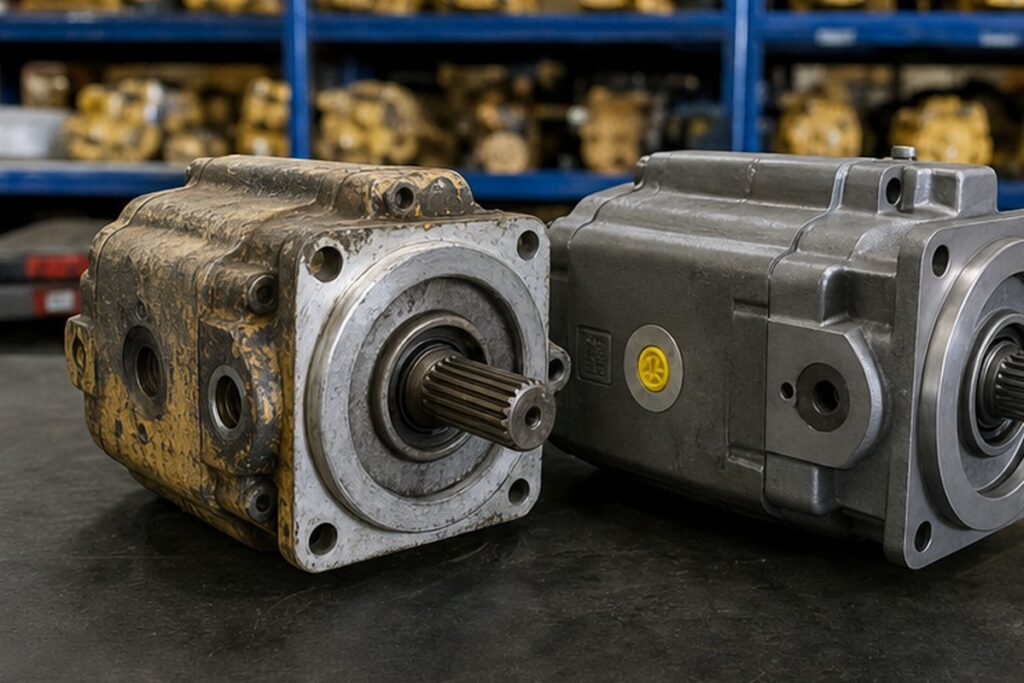
Excavator part number verification means checking that the requested number, machine configuration and actual replacement all agree. Start with the manufacturer and machine model, then use the serial or PIN context, the installed part’s markings, photos and relevant dimensions to confirm the match. A number copied from a catalogue or another seller’s listing is a lead to investigate, not proof that the quoted item is correct.
You can contact PRIMA with the number or photos you already have. You do not need a complete technical file to start. Before an order is confirmed, unresolved differences should be identified and the proposed part, fitment basis, condition and included items recorded in writing.
Buyer summary
- Keep part numbers, machine serial numbers and casting marks separate.
- Check the correct catalogue and serial range, including any replacement-number history.
- Compare the actual installed part with the actual item being quoted.
- Verify genuine origin, fitment, condition and availability independently.
Send the number or photos you have. For buying options, see the excavator parts supplier guide.
Identify which number you are reading
Photograph the complete label or marked area as well as the surrounding component. A typed number without context can hide a missing prefix, suffix, worn character or a number taken from the wrong assembly.
| Identifier | How to use it |
|---|---|
| Part number | Check the manufacturer, catalogue description and supply scope. A number may refer to a subcomponent rather than the complete assembly you need. |
| Machine serial / PIN | Use it to establish machine identity and catalogue applicability. Also disclose modifications or previous component replacement. |
| Casting or stamped mark | Treat it as a clue until its meaning is confirmed. A housing mark is not necessarily the ordering number for the finished assembly. |
Use the correct catalogue, not just a matching search result
Use the manufacturer’s official parts resources or an appropriate dealer. For Cat equipment, Cat’s official parts reference guides provide a starting point for parts identification, with further searching by machine serial number, model or equipment category. Manufacturer resources help establish the reference; they do not verify the origin or condition of a third-party seller’s physical item.
- Confirm that the document covers the correct manufacturer, model and serial range.
- Record the publication or catalogue version, diagram group and item position where available.
- Check whether the listing is for one part, a kit, a pair or a complete assembly, and what is included.
- If a different number is offered as a replacement, ask for the source of the cross-reference or supersession and any accompanying installation requirements.
- Compare the catalogue result with the installed part and the proposed replacement before approval.
Use manuals and diagrams through lawful manufacturer or authorised sources. PRIMA is not publishing an official manufacturer catalogue or offering unauthorised manual downloads. A parts diagram helps identify components; it is not a substitute for the correct service procedure.
When the tag is missing or unreadable
A missing number does not prevent an initial enquiry. Send clear overall and close-up photos, the machine model and where the part is installed. Include any readable letters or digits, marking uncertain characters rather than guessing them.
After the component is identified, agree which measurements matter. For example, the relevant checks may be mounting holes and flanges, a shaft or spline, hydraulic ports, electrical connectors, or track-chain pitch and link count. Do not send every possible measurement indiscriminately; use the checks for the component being considered.
Take photos only where access is safe. Leave disassembly and work around pressurised or moving components to a qualified technician following the machine’s service instructions. If the available evidence cannot distinguish variants, the match should remain unconfirmed.
Related checklists: general parts fitment, final-drive assembly and interfaces, and genuine undercarriage parts.
Ask the supplier to explain the proposed match
A useful response identifies the requested part and the offered part, the information used to match them and any details still missing. Ask for current photos of the quoted item, not only a catalogue picture. Compare labels, connections, dimensions and included pieces on the same basis.
- Direct number match: record the number and its manufacturer context, then confirm the applicable machine and supply scope.
- Cross-reference or superseded number: identify who provides the replacement reference and which conditions apply.
- Conditional quotation: state the missing photo, measurement or serial information that must be resolved before approval.
If a number and the visible interfaces disagree, stop the approval and investigate the discrepancy. Do not resolve it by selecting whichever clue supports the cheapest offer. For whole-machine purchases, keep the part details with the machine identity and inspection record so later orders refer to the same unit.
What a number match does not establish
A matching number alone does not prove genuine origin, current stock, new condition, successful testing or a warranty. For genuine parts, ask for markings, packaging where applicable and traceable source information. For used or rebuilt items, request the actual condition, disclosed work and relevant test records. A serial number or seller label by itself is not an authenticity certificate.
Keep brand/source and condition separate in the offer: an original-brand item can be used or rebuilt, while a new item can be aftermarket. Confirm quantity, unit of sale, availability date, included components, packing and any written warranty or return terms for the specific order. PRIMA uses manufacturer names to identify requirements and does not claim authorised-dealer status.
Keep the approved item linked to the shipment
Before dispatch, compare the final item photos and quantity with the approved order. Record how ports, shafts and machined surfaces are protected and how heavy components are restrained in the package. Keep the packing photos and package details with the identification record; they help the receiving team check that the approved item arrived.
The parts enquiry checklist can help organise a larger order. The parts reference catalogue is a browsing aid, not confirmation of current inventory or fitment.
Frequently asked questions
These answers explain how to start and which decisions need further confirmation.
Can I ask for help without a complete part number?
Yes. Send the machine model, where the part is used and clear photos if available. State any uncertain characters. Further identification and fitment details can be collected before an order is confirmed.
Is a casting number the same as a part number?
Not necessarily. A casting mark may identify a housing or manufacturing reference rather than the complete orderable assembly. Confirm its meaning through the appropriate catalogue or manufacturer information and compare the actual component.
Does a matching serial number prove a part is genuine?
No. Identification and authenticity are separate checks. A number may help trace a component, but a genuine-origin claim also needs supporting markings and source evidence for the actual item being offered.
Send the number or photos you have
Tell PRIMA which part you need and how to reply. A model, readable number or clear photo is a useful start; we can ask for the remaining identification details after reviewing your requirement.