
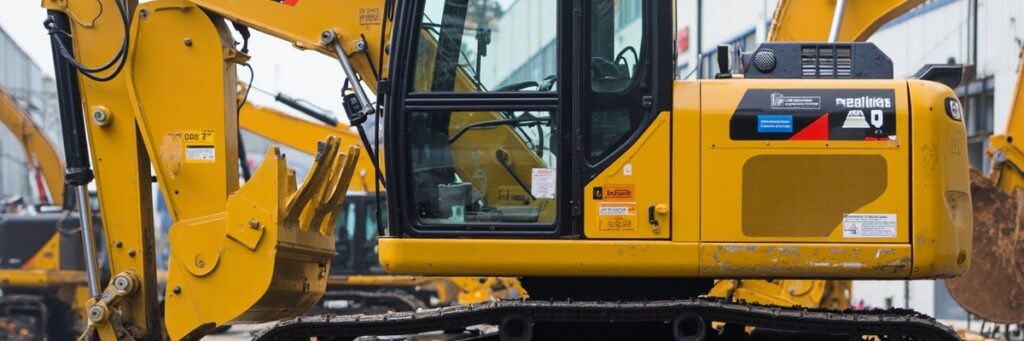
The used excavator market in 2026 is being shaped by selective construction recovery, firm demand for earthmoving equipment, tighter capital decisions, and a stronger need to prove condition before comparing prices. There is no single worldwide price direction: auction volume, age, hours, configuration, region, financing, shipping and exact-machine condition can move differently at the same time.
Buyer Summary: Use market reports to understand direction, then value the exact excavator through an identity file, comparable condition evidence and total landed cost. A broad market average is not a substitute for inspecting the machine you may buy.
What are the key trends influencing the used excavator market?
Five trends matter most to global buyers in 2026. Construction demand is recovering unevenly by region and sector. Used earthmoving sales can remain firm even when buyers are cautious about capital. More contractors are mixing used purchases, rentals and selective ownership. Prices are increasingly interpreted alongside age, hours and supply volume. Finally, cross-border buyers are placing more value on evidence that connects the quoted machine to inspection, repairs, loading and documents.
| 2026 trend | What the available evidence says | Buyer response |
|---|---|---|
| Uneven construction recovery | Growth differs by region and by infrastructure, energy, industrial, commercial and residential work. | Match machine type and timing to a real project pipeline, not a global headline. |
| Firm earthmoving demand | North American auction evidence showed higher excavator volume with maintained or improved median prices in Q1 2026. | Do not assume that more listings automatically mean a lower comparable price. |
| Flexible fleet strategies | Contractors are combining ownership, used purchases and rental to control capital and utilization. | Compare purchase, rental and downtime cost for the intended project duration. |
| Condition-adjusted pricing | Age, usage, specification and sale channel can change the meaning of a price movement. | Normalize comparisons before using them in a negotiation. |
| Evidence-led cross-border buying | Shipping and import risk make an undocumented low price less useful to an overseas buyer. | Build one auditable file from quote through receiving. |
What are the current sales trends for new and used excavators?
Construction demand is stabilizing, but not uniformly
The Association of Equipment Manufacturers reported in February 2026 that global construction output had grown only modestly in 2025 and was expected to improve in 2026. Its regional picture was mixed: South Asia, Southeast Asia, and the Middle East and North Africa were stronger contributors, while several other regions declined in 2025. This is a construction-demand signal, not a direct worldwide used-excavator sales count.
Used earthmoving auction results showed resilience
Ritchie Bros. reported that dozers, excavators, motor graders and articulated dump trucks had higher Q1 2026 auction volumes than in Q1 2025 in both the United States and Canada, while median prices were maintained or improved. Its retail construction index was broadly flat quarter to quarter. These findings support a picture of resilient used-earthmoving demand in those channels, but they must not be presented as a global price index.
Capital pressure is increasing interest in used equipment
A 2026 Ritchie Bros. summary of EquipmentWatch survey findings said 27% of contractors planned to buy more used equipment, five percentage points more than in 2024; cost savings and immediate availability were identified as drivers. The same report described a mixed ownership model in which contractors buy core machines and rent variable project needs. For a buyer, this means a used excavator competes not only with a new unit, but also with rental, lease and delayed procurement.
Read the underlying sources directly: the Ritchie Bros. Q1 2026 market-trends report, the AEM 2026 construction outlook, and the Ritchie Bros. construction-equipment economy summary.
Why can used-excavator prices stay firm while sales volume rises?
Volume and price do not move in a fixed one-for-one relationship. A quarter with more transactions can also contain younger machines, fewer hours, different model classes, stronger project demand or a different geographic mix. Auction results may also differ from dealer retail asking prices. A firm median therefore does not prove that every used excavator became more valuable.
| Comparison variable | Why it changes price | Evidence to collect |
|---|---|---|
| Identity and generation | Two machines with the same family name may have different engines, electronics or emissions packages. | Serial or PIN area, model plate, engine label and regional configuration. |
| Age and hours | Calendar age and meter reading affect expectations but do not prove condition. | Hour-meter photo, monitor startup, service history and wear evidence. |
| Undercarriage and hydraulics | Near-term repair exposure can outweigh a modest purchase-price difference. | Measurements, cold start, function test, drift, leak and travel evidence. |
| Attachment and specification | Boom, stick, bucket, track shoes and auxiliary circuits affect job fit and transport. | Dated configuration photos and written included scope. |
| Sale channel and location | Auction, retail, private sale and export quote include different services and risks. | Comparable channel, delivery point, taxes, buyer fees and included work. |
Use PRIMA’s used excavator inspection checklist to convert a market comparison into exact-machine evidence.
How should buyers compare new and used excavators in 2026?
Compare project economics, not only purchase price
A new machine may offer a clearer specification, manufacturer support and a warranty defined by the seller or manufacturer. A used machine may offer lower acquisition cost and faster availability. Neither choice is automatically cheaper after financing, mobilization, downtime, repairs, parts support and resale value are included.
Use the same decision horizon
Compare both options over the expected project or ownership period. If a used machine needs undercarriage work soon after arrival, that cost belongs in the decision. If a new machine has a long lead time that delays a project, that delay also belongs in the comparison. Financing approval, exchange rates and shipping schedules can change the result before the machine moves.
| Decision | New machine question | Used machine question |
|---|---|---|
| Availability | What is the confirmed production and delivery date? | Is this exact unit available and tied to current dated evidence? |
| Support | What warranty and local dealer scope is written? | Which parts, diagnostics and repair support are realistically available? |
| Capital | What are deposit, financing and cash-flow requirements? | What repair reserve and inspection cost should be added? |
| Project fit | Does the ordered configuration match the work? | Does the existing configuration match without costly conversion? |
For capital planning, use the excavator financing guide. Treat any approval, rate or term as lender- and buyer-specific, not as a website promise.
Which regional signals matter to global buyers?
Infrastructure and energy work can support earthmoving demand, but regional growth does not prove demand for every excavator size. A 20-ton crawler excavator, a compact excavator and a mining-class unit serve different projects. Buyers should connect the machine class to funded work, local contractor capacity, transport limits, fuel quality, operator skills and parts access.
For Africa-specific context, use the used excavator market in Africa guide. It is a regional decision page, while this page remains the global market-trends owner. Country-level import and emissions rules still require verification with the buyer’s broker and authorities.
What evidence should a global buyer request before relying on a market price?
Start with the exact machine, not a stock photo or a model-family average. Request a dated walkaround, serial-area evidence, a true cold-start video, full hydraulic and travel functions, undercarriage close-ups, known repair history, included attachments and a written condition boundary. Then connect the accepted unit to payment, loading and documents.
Use the supplier evidence guide to review the seller, the pre-shipment inspection guide for the release gate, and the shipping and document checklist for handoff. Parts support should also be checked by exact model and serial context through the excavator spare-parts sourcing guide.
How should buyers calculate total landed risk?
Total landed risk is broader than the supplier’s machine price. Add inspection, approved repairs, inland transport, dismantling if required, loading, ocean freight, insurance, destination charges, duties and taxes, compliance work, reassembly, initial service and a repair reserve. Record which figures are quotations, which are estimates and which remain unknown.
A low headline price is not a saving if the machine identity changes, the loading method is unsuitable, documents are incomplete or a major component fails shortly after arrival. Conversely, a higher quoted price is not automatically better unless the added services and evidence are written and verifiable.
Market evidence boundary
This page uses public 2026 construction and used-equipment evidence to describe direction, not to publish a universal forecast or a PRIMA inventory claim. The Ritchie Bros. evidence cited above is mainly from United States and Canadian auction or retail channels. AEM construction-output estimates are demand context rather than direct used-excavator transaction data. Conditions can change after publication, and country, machine class, age, hours, condition and sale channel may produce a different result.
PRIMA does not claim that a specific machine is available, inspected, certified, compliant, warrantied or suitable for import unless those facts are supported in the current exact-unit commercial file.
Frequently asked questions
Are used excavator prices rising in 2026?
Some Q1 2026 North American auction evidence showed maintained or improved median prices for excavators alongside higher volumes. That does not establish a worldwide price rise. Normalize age, hours, configuration, condition, channel and location before drawing a conclusion.
Why are buyers choosing used excavators?
Cost, immediate availability and flexible fleet planning are important drivers. The correct decision still depends on inspection evidence, expected utilization, financing, repair exposure, parts support and total landed cost.
Is a market-average price enough to approve a purchase?
No. A market average helps with orientation. Purchase approval should be tied to the exact machine identity, comparable condition evidence, written scope, inspection, payment controls, loading and documents.
Does higher sales volume mean prices should fall?
Not necessarily. The mix of machine age, hours, quality, model class, region and demand can allow volume and median price to rise together. Review the dataset and composition before interpreting the direction.