
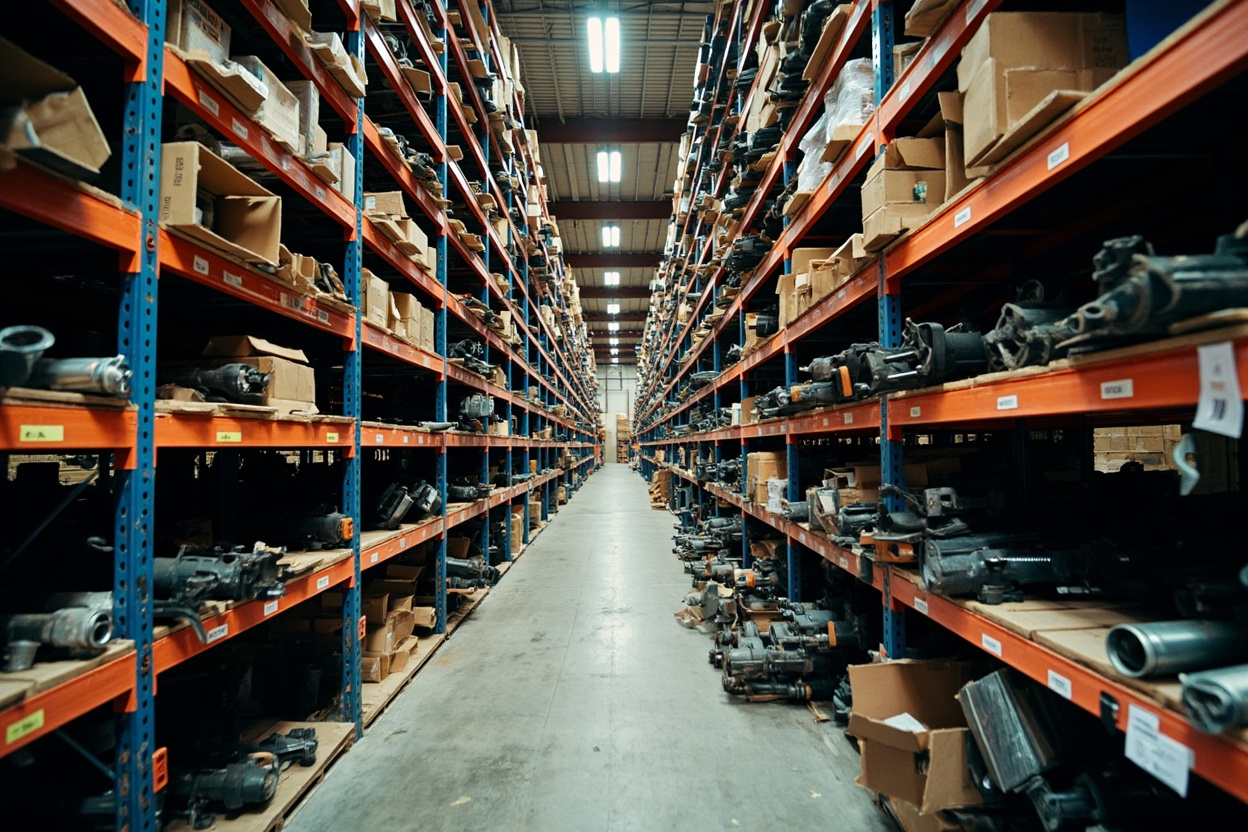
Buyer summary: A useful one-stop excavator spare parts shop does not simply claim that every part is available. It turns a mixed parts request into one controlled RFQ while keeping machine identity, part identity, condition, fitment, availability, testing, packing and commercial evidence separate for every line item. Use the checklist below to prepare a quote that can be compared and approved without hiding weak items inside a large order.
This page owns the one-stop excavator spare parts sourcing and RFQ-consolidation decision. For a deeper comparison of official/OEM, aftermarket, used and rebuilt supplier routes, use the excavator parts supplier buyer guide. For exact part-number and fitment work, use the spare parts fitment checklist. For manufacturer-led catalogue and service routes, use the OEM sourcing guide. These are supporting owners, not duplicate one-stop pages.
What “one-stop” should mean in a parts RFQ
One-stop sourcing should mean one request file, one line-item register, one evidence review and one coordinated commercial response. It should not mean that every quoted item is automatically in stock, genuine, compatible or covered by the same warranty. Those are separate facts that need separate evidence.
A buyer may combine filters, seals, undercarriage parts, electrical items, a hydraulic pump and a final drive in one RFQ. The order can be coordinated together, but each line still needs its own identity and acceptance status. If one line cannot be verified, mark that line hold; do not let it delay or contaminate the evidence for the other lines.
| Decision gate | Minimum buyer input | Supplier evidence to request | Hold when |
|---|---|---|---|
| Machine identity | Brand, complete model and readable serial/PIN context | The exact machine identity used for the proposal | The quote relies only on a broad model family |
| Part identity | Part number, old-part label/casting marks, photos or dimensions | Proposed part number, supersession note if applicable, and item-linked photos | The proposed item cannot be tied to the requested line |
| Condition route | Accepted route: official/genuine, aftermarket, used, rebuilt or open to alternatives | Named manufacturer or source and a plain condition statement | “OEM quality” or “original” is used without a verifiable source |
| Fitment | Machine serial/PIN plus relevant interfaces | Fitment basis and any dimensions, ports, splines, voltage or mounting details used | Fitment is inferred from appearance or model name alone |
| Availability | Quantity and required timing | Dated stock or production status for that exact item and quantity | Generic warehouse photos are offered as stock proof |
| Testing | Required checks based on category and condition | Item-linked method, conditions, readings, date and result where relevant | A generic test video is not traceable to the proposed item |
| Packing and consolidation | Destination, transport constraints and split-shipment rule | Item protection, package plan, marks, dimensions/weight method and release photos | Packing is described only as “export standard” |
| Commercial scope | Currency and preferred Incoterm or delivery scope | Included/excluded charges, quote validity, warranty boundary and document list | The price cannot be compared on the same scope |
Build a quote-ready excavator parts list
Start with a spreadsheet or table in which every requested part has a unique line ID. Repeating the machine model at the top of a message is not enough when the RFQ covers several machines or model suffixes.
- Line ID: use a stable reference such as EX01-001 so photos, revisions and supplier replies stay attached to the same request.
- Machine identity: record brand, full model, suffix and serial/PIN. Add engine or component serials when the requested part is controlled by a subassembly.
- Requested part: record the current part number, part name and machine position. If the number is uncertain, label it “to verify” instead of guessing.
- Old-part evidence: add readable labels, casting marks, connector/port views, mounting faces and measurements relevant to the category.
- Condition route: say which routes are acceptable. A buyer open to both aftermarket and rebuilt options should request separate, clearly labelled alternatives.
- Quantity and priority: identify the quantity, critical lines and whether partial release is acceptable.
- Destination and scope: provide destination country, nearest port or city, and the requested commercial scope. Customs eligibility and charges remain destination-specific until checked.
If the part number is missing, use the part-number verification workflow before treating a quotation as fitment-approved.
Minimum line-item template
| Field | Buyer entry | Supplier response |
|---|---|---|
| Line ID | EX01-001 | Repeat unchanged on quote, photos and packing list |
| Machine | Brand / full model / serial or PIN | Identity used for fitment review |
| Requested part | Part number / name / position | Proposed number and any disclosed supersession |
| Reference evidence | Old-part photos / label / dimensions | Proposed-item photos and matching interfaces |
| Status | Accepted condition route | Manufacturer/source and condition, stated separately |
| Quantity | Required quantity | Dated status for the exact quantity |
| Checks | Category-specific requirement | Method, result and item linkage where relevant |
| Commercial | Currency / Incoterm / destination | Price scope, validity, warranty boundary and exclusions |
| Release | Inspection and split-shipment rule | Packing plan, marks, documents and release evidence |
Add category-specific evidence gates
The same RFQ structure can cover many categories, but the fitment and inspection evidence is not interchangeable.
- Hydraulic pump, swing motor and travel motor: request nameplate or casting identity, shaft, mounting, port layout, controller/regulator configuration and relevant test evidence. See the hydraulic pump buyer guide.
- Final drive and travel gearbox: record flange and bolt pattern, shaft/spline details, ports, rotation context, machine position and disclosed condition. See the final drive buyer guide.
- Undercarriage: record machine serial context, position, pitch, link or roller dimensions, mounting pattern and quantity by side. Wear status must be item-linked when used parts are proposed.
- Electrical parts: record voltage, connector shape and pin count, module or sensor number, software/calibration dependency if known, and label views.
- Engine and fuel-system parts: include engine model and serial, component number, mating interfaces and whether the proposed item is new, used or rebuilt. A rebuilt label needs a disclosed work scope, not just new paint.
- Filters, seals and service kits: list every included number or component. Do not accept a kit name as proof that its contents match the machine serial.
- Bucket teeth and ground-engaging tools: record the adapter/profile system, pin/retainer arrangement and dimensions; appearance alone is not a fitment check.
Use official catalogue routes as verification starts
Manufacturer resources can help establish the correct machine and part-number context. They do not prove that an independent supplier’s proposed item is genuine, available or compatible.
- Caterpillar: the official Cat Parts Diagram starts with equipment and serial-number context before presenting relevant diagrams.
- Komatsu: My Komatsu is the manufacturer route for machine-linked parts and support information. Use the manual or parts book that matches the machine serial context.
- SANY: MySANY provides manufacturer-led equipment, parts-manual and service entry points; SANY also maintains an official parts page.
For other brands, start from that manufacturer’s current official parts or service channel. Keep screenshots or references that show which serial/PIN and part number were checked. A catalogue lookup is one evidence input; it is not a substitute for proposed-item identity.
Compare supplier responses with pass, clarify and hold
Normalize every supplier response into the same line-item table before comparing price. Use three working statuses:
- Pass: identity, route, fitment basis, dated availability, commercial scope and required inspection evidence are present and consistent for the line.
- Clarify: the proposal may be usable, but one or more fields need a specific answer or better item linkage.
- Hold: the requested or proposed part cannot yet be tied to the machine, condition or commercial claim. Hold is not a rejection; it prevents an unsupported assumption from becoming an order.
Compare landed-cost components only after suppliers use the same currency and scope. Product price, packing, domestic movement, international freight, insurance, destination charges, duties and taxes may be included differently. Record the exact Incoterm location and exclusions rather than applying a generic freight estimate.
Control consolidation, packing and release
A mixed parts order can contain small seals, heavy steel wear parts, precision hydraulic assemblies and electrical components. One outer shipment does not mean one packing method.
- Map every package back to the RFQ line IDs.
- Separate clean or precision parts from loose, oily, abrasive or impact-heavy items.
- Request protection for ports, shafts, connectors, machined faces and moisture-sensitive items as relevant.
- Confirm package count, marks and the method used to determine dimensions and weight before freight release.
- Match invoice and packing-list descriptions to the accepted line register; resolve substitutions before dispatch.
- Request dated packing and release evidence that can be traced to the accepted items. Generic warehouse or container images are not line-item proof.
Send a qualified one-stop parts RFQ
PRIMA can review a consolidated excavator-parts request after the buyer provides enough information to identify the machine and requested lines. A request is not treated as fitment-confirmed, available or accepted until the proposed items and evidence are returned and reviewed.
Include these six fields in the first message:
- machine brand, full model and serial/PIN;
- part number or old-part photos, labels and relevant dimensions;
- part name, machine position and quantity for each line;
- accepted condition routes: official/genuine, aftermarket, used, rebuilt or alternatives;
- destination country and nearest port or city; and
- required timing and whether partial release is acceptable.
Send the one-stop parts RFQ or contact PRIMA through [email protected] / WhatsApp +86 138 2031 8813. PRIMA’s contact routing retains source context where supported; a page visit or form load is not an inquiry.
Buyer FAQ
What information should a one-stop parts RFQ include?
Include a line ID, machine brand and full model, serial/PIN, requested part number or old-part evidence, part name and position, quantity, accepted condition route, destination and timing. Attach category-specific measurements or interface photos when fitment depends on them.
Does one-stop sourcing mean every part is in stock?
No. One-stop describes the coordination method. Availability must be confirmed for each exact proposed item, quantity and date. An undated catalogue, product card or warehouse image is not current stock evidence.
Can OEM, aftermarket, used and rebuilt parts share one quote?
They can share one RFQ, but every alternative should be a separate, clearly labelled quote line. Record the manufacturer or source, condition, fitment basis, inspection evidence, warranty boundary and price scope for each route. Do not merge different routes into one ambiguous “OEM quality” description.
What evidence should buyers review before payment?
Review the proposed-item identity, fitment basis, source and condition, dated availability, any relevant test evidence, accepted price scope, quote validity, warranty and exclusions, packing plan, document list and release-control method. Keep unresolved lines on hold.
How should buyers handle a missing or uncertain part number?
Label the number as unverified and provide the full machine identity plus readable old-part labels, casting marks, mounting and interface views, and relevant dimensions. Use the correct manufacturer catalogue or service route to narrow the number, then require the supplier to state the exact identity used for the proposal.