
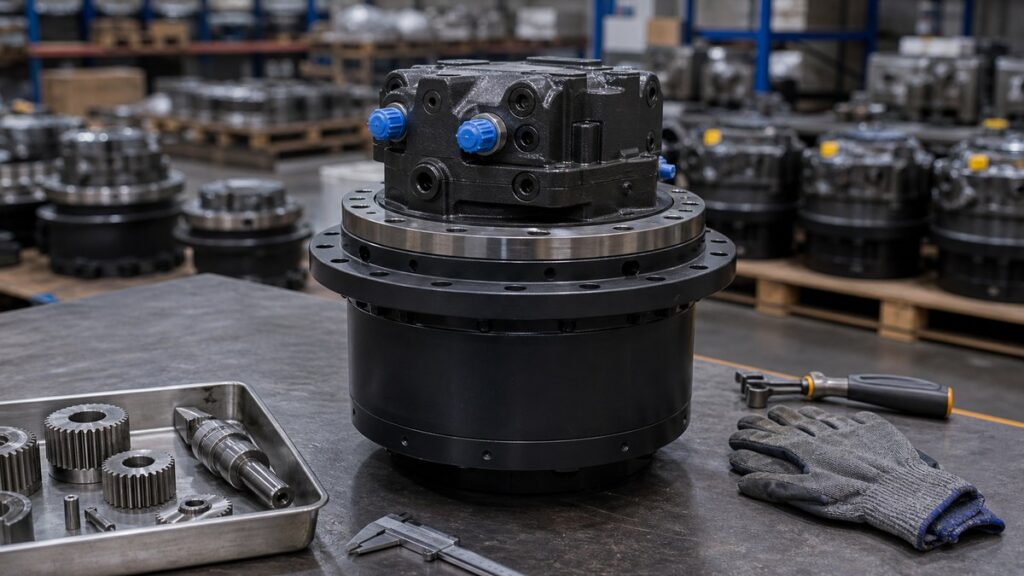
An excavator final drive transfers power to a track through a travel motor and reduction gearbox. In quotations, however, “final drive” may mean the complete assembly, the hydraulic motor alone or the gearbox alone. Confirm what is included before comparing prices. A matching model name or similar-looking housing is not enough to confirm that a replacement fits.
This guide explains the buying checks for the quoted unit: machine identity, connections, brand and source, new or used condition, testing and packing. If you are not sure which assembly you need, start with the machine model and a clear photo of the old unit. Detailed measurements can follow after the requirement is understood.
Buyer summary
- Compare the same supply scope: complete assembly, motor only or gearbox only.
- Check the serial context and actual interfaces before order confirmation.
- Treat genuine identity, condition and fitment as separate questions.
- Request test and packing records for the actual unit being offered.
Ask PRIMA about a final drive or browse the excavator parts buying guide.
Complete final drive, travel motor or reduction gearbox
The hydraulic motor supplies rotary motion; the reduction gearing adapts speed and torque for the drive. Bosch Rexroth describes planetary gearboxes combined with hydraulic motors for tracked-vehicle propulsion. That explains the component distinction, not the compatibility of any particular replacement.
| Quote scope | Confirm in writing |
|---|---|
| Complete assembly | Motor and reduction gearbox included; identify any valves, brake components, fittings and hardware supplied. |
| Motor only | The motor-to-gearbox interface and what must be reused. Do not assume the gearbox is included. |
| Gearbox only | The motor interface, reduction specification and mounting. Do not assume a hydraulic motor is included. |
Ask separately whether the sprocket, bolts, seals and other installation items are included. A photo containing those items does not make them part of the price. Travel drive components move the tracks; they are different from the swing motor that turns the upper structure.
Six fitment checks before approving an order
- Machine identity: full make, model and serial or PIN, plus any known replacement history. A machine that has already been modified may not have its original drive.
- Old unit identity: photograph the tag, stamped numbers and complete unit from both sides. A part number is a starting point for matching, not proof of genuine origin.
- Frame and sprocket mounting: compare mounting faces, locating diameters, bolt count and spacing, and the sprocket interface. Use clearly labelled measurements agreed with the supplier.
- Hydraulic connections: compare the actual port arrangement, connection sizes and specified functions, including drain, speed-control or brake connections where applicable. Do not identify a port from its position alone.
- Motor and gearbox specification: confirm the relevant motor code, displacement, speed configuration and gear ratio from the machine documentation or component specification. A housing that bolts on may still be the wrong specification.
- Written match: ask the supplier to identify the proposed unit, included items and any unresolved differences against your photos and details before payment.
For a more detailed photo list, use the travel-motor port and flange checklist. The general parts-fitment checklist helps organise part numbers and measurements.
Separate genuine identity from new, used or rebuilt condition
“Genuine” describes origin; “new”, “used” and “rebuilt” describe condition. They are not four interchangeable quality grades. An original-brand unit can be used or rebuilt, while a new unit may be an aftermarket replacement. Ask for both the brand/source description and the condition in the quotation.
- Genuine/OEM claim: identify the claimed manufacturer, exact part number, markings, packaging where available and supporting source documents. A copied label or serial number alone does not establish authenticity.
- Aftermarket replacement: identify the actual manufacturer and specification. Confirm the fitment basis, not simply a list of compatible model names.
- Used unit: request current photos, disclosed defects and available operating or test records. Fresh paint is not a performance test.
- Rebuilt unit: request a dated work description, which components were replaced or reused, and the final test record. “Rebuilt” without a stated scope is not enough to compare two offers.
This is a comparison guide, not a live inventory list or a promise that every option is available from PRIMA. Availability, the offered unit, condition and any warranty must be confirmed for the specific enquiry. Manufacturer names are used for identification; PRIMA does not claim authorised-dealer status.
Check the fault before buying a replacement
Weak travel does not, by itself, identify which component needs replacing. Have a qualified technician diagnose the machine using the correct service information before approving a motor or gearbox purchase. Describe whether the issue affects one or both tracks, occurs hot or cold, and includes leakage, noise or a speed-change problem.
Share existing diagnostic results with the supplier rather than attempting pressure adjustments or hose changes based on a general buying article. Our weak-travel diagnostic checklist helps organise questions for the technician; it does not replace the model-specific service procedure.
Review testing, packing and the written offer
A useful test record identifies the actual quoted unit, the date, test method and conditions, measurements taken and the acceptance criteria used. Ask what was not tested as well as what was tested. A short no-load video or a generic test-bench picture cannot establish full operating performance.
Before shipment, match the unit tag and included components to the order. Request photos showing capped connections, protected machined surfaces, restraint against movement and packaging suitable for the unit’s weight and route. Record the package count, dimensions and gross weight. Agree how transit damage, shortages and a fitment discrepancy should be reported.
Compare offers on the same basis: unit and quantity, included items, condition, testing, packing, destination, delivery terms and written warranty scope. Confirm availability and lead time when the offer is issued; neither a catalogue page nor an old photograph confirms current stock.
Frequently asked questions
These answers cover the first enquiry and what must still be confirmed before an order.
Can I start an enquiry without the part number?
Yes. Send the machine model and a clear photo if available, plus a way to reply. The serial context, tag and interface details can be collected before a replacement is confirmed. Do not order from the model name alone.
Does a final-drive quote always include the hydraulic motor?
No. Sellers may use the term for a complete assembly or for a gearbox alone. Ask for a written list of included components and photos of the actual offered unit.
Does a test video prove the final drive will fit?
No. Testing and fitment answer different questions. A video must be tied to the offered unit, and the machine identity, mounting, connections and specification still need to be matched.
Ask PRIMA about your requirement
Tell us what you need and how to reply. If available, include the machine model and one clear old-unit photo. We can then identify which additional details are needed; you do not need a complete technical file for the first message.
Useful model checks: Komatsu PC220 final drive and Volvo final drive and travel gearbox. For a whole-machine purchase, start with the used-excavator inspection checklist.
Other languages: Español: mando final · Português: comando final.