
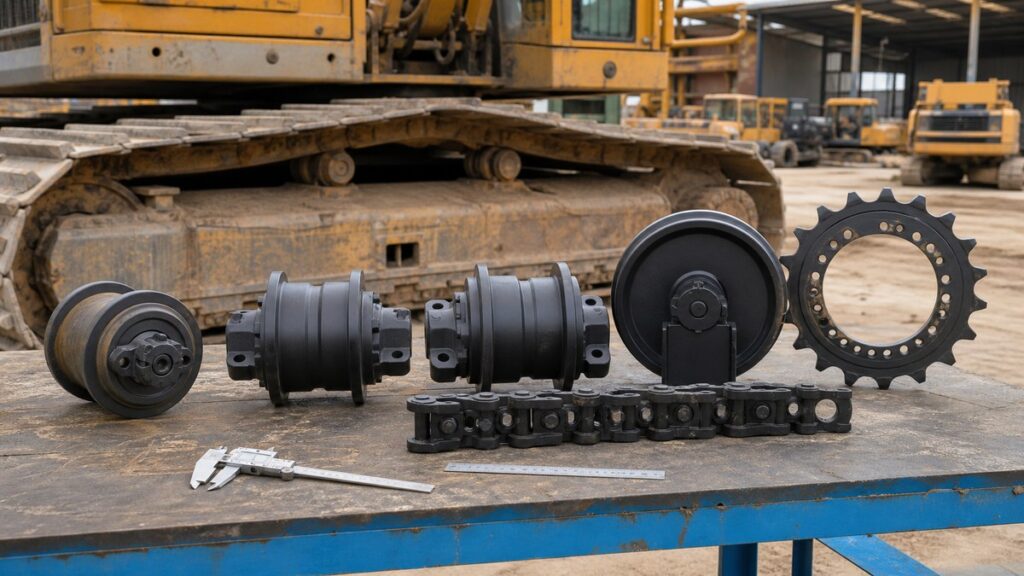
PRIMA Equipment handles enquiries for new genuine excavator undercarriage parts from Baoding, Hebei, China. Start with the part number, or send the machine model and clear photos of the part you need. The proposed part, source, condition, fitment and quotation scope must be confirmed for your order.
Request a Genuine Parts Quote Email PRIMA
No part number yet? Tell us what needs replacing and send the photos you have. Quantity and destination help us prepare a useful quote; technical details can follow after the first enquiry.
Before you order
Genuine origin, new condition, correct fitment and current availability are four separate checks. A model name or matching number does not prove all four. This page explains our enquiry process; it is not a live stock list or evidence that a particular part has passed verification.
Choose the undercarriage component
Identify the component and the supply unit before comparing prices. A bottom roller is not a carrier roller, and a single chain link is not a complete track chain.
- Track rollers / bottom rollers: confirm roller position, flange arrangement, mounting dimensions and quantity per machine or per side.
- Carrier rollers / top rollers: confirm the upper support position, shaft and bracket interface. Do not substitute a bottom-roller listing.
- Front idlers: confirm whether the quote is for the wheel alone or an assembly with brackets. A spring or track adjuster is not automatically included.
- Sprockets: identify a complete wheel or segments, mounting pattern and chain match.
- Track chains: specify bare chain or chain with shoes, link count, pitch and one-side or two-side quantity.
- Track shoes and hardware: confirm shoe width, hole pattern, quantity and whether bolts and nuts are included.
For CAT, SANY or Doosan enquiries, send the complete model designation rather than only the brand or series. A CAT 320-series name is a starting point, not a universal fitment specification. Availability is confirmed for the particular part, not assumed across a brand’s full range.
What makes a genuine-parts quotation different?
Ask for the proposed manufacturer’s brand and ordering part number, actual part and packaging photos, and the available source evidence for that item. A casting mark, serial number, logo or reference number alone is not enough to establish genuine origin. Terms such as “fits CAT” or “OEM quality” must not be treated as proof of a genuine CAT part.
PRIMA is an independent supplier. Brand names identify the requested equipment or part; this page does not claim manufacturer authorization. If the requested genuine part cannot be confirmed, resolve that before ordering. An aftermarket alternative must be identified separately, not presented as the same genuine item.
| Check | Evidence to agree before ordering |
|---|---|
| Origin and condition | Proposed brand, ordering number, actual markings and packaging, available source evidence, and a clear new / used / rebuilt description. |
| Fitment | Full model, relevant machine serial range, old-part photos and dimensions needed for that component. Modified machines require additional checks. |
| Availability and scope | Dated availability confirmation, quantity, each / side / set pricing, included hardware, packing and dispatch estimate for the quoted order. |
Older entries in the parts reference catalogue are not automatically new genuine stock. Use a record to identify your enquiry, then request the current proposed item and its evidence.
How can you compare two undercarriage quotations on the same basis?
Compare the same machine, part specification, quantity and delivery scope before comparing totals. A bare track chain is not equivalent to a chain with shoes and hardware; a one-side quotation is not an entire-machine set. Copy each supplier’s written details into the worksheet below. Mark missing information Not confirmed, rather than assuming it is included or free. This is a comparison worksheet, not a price list or a compatibility approval.
How to use it: copy this table into your purchasing sheet, replace the two quote columns with the suppliers’ actual wording, and resolve every material difference before selecting a supplier. On a phone, scroll the table sideways.
| Check | Quote A | Quote B | Resolve before comparing |
|---|---|---|---|
| Date, validity, currency and delivery terms | Enter quoted detail / Not confirmed | Enter quoted detail / Not confirmed | Use a common currency basis and the same named delivery scope; an expired quote needs reconfirmation. |
| Full machine model, suffix and relevant identification | Enter quoted detail / Not confirmed | Enter quoted detail / Not confirmed | Match the relevant serial/PIN range and part number or requested measurements. Similar model names do not establish fitment. |
| New/genuine status and origin evidence | Enter quoted detail / Not confirmed | Enter quoted detail / Not confirmed | Keep new genuine parts separate from aftermarket, used or rebuilt alternatives. A part number alone does not prove origin. |
| Quantity and unit: each, one side or full-machine set | Enter quoted detail / Not confirmed | Enter quoted detail / Not confirmed | List each component and its quantity. The word “set” must be defined by the supplier. |
| Track-chain assembly scope | Enter quoted detail / Not confirmed | Enter quoted detail / Not confirmed | State bare chain or chain with shoes, shoe width, link count and whether bolts/nuts are included, where applicable. |
| Roller, idler and other assembly inclusions | Enter quoted detail / Not confirmed | Enter quoted detail / Not confirmed | Confirm the actual assembly supplied and separately listed brackets, adjuster or related hardware; do not infer inclusions from a photograph. |
| Parts price, packing and dispatch timing | Enter quoted detail / Not confirmed | Enter quoted detail / Not confirmed | Separate the quoted parts amount from packing or other fees. Distinguish estimated dispatch from confirmed availability. |
| Freight, destination charges and installation | Enter quoted detail / Not confirmed | Enter quoted detail / Not confirmed | Record included/excluded transport, applicable local charges, labour and installation. PRIMA’s parts enquiry is not an automatic installation offer. |
| Written warranty and claim costs | Enter quoted detail / Not confirmed | Enter quoted detail / Not confirmed | Compare coverage, exclusions and who bears labour, return freight or other claim costs. Do not replace the written terms with “one-year warranty.” |
| Comparable total and unresolved amounts | Enter confirmed total / unresolved items | Enter confirmed total / unresolved items | Add only confirmed amounts for an agreed common scope. Keep unknown charges visible; do not declare a cheaper delivered option while material items remain unresolved. |
Decision rule: if specification or scope differs, ask for a revised quotation or list the difference separately. Choose between confirmed comparable offers; do not force an unknown amount into a zero-price cell. Prices, availability and fitment still require enquiry-specific confirmation.
For a PRIMA enquiry, use the WhatsApp or email quotation route above. Send the machine model and whatever identification, part numbers, photographs, quantities and destination you already have. Incomplete information is welcome; we will identify what needs clarification before recommending or quoting a part.
How we work through your enquiry
- Start with what you know. Send the part number or machine model and photos, plus a way to reply. Add quantity and destination if known.
- Resolve identification and fitment. Confirm the model suffix, configuration and relevant measurements. Read the parts fitment checklist for the information that may be needed next.
- Review the proposed supply. Match the quotation to the actual item, source and condition evidence. Agree included components, current availability and any unresolved point before payment.
- Agree delivery and after-sales scope. Confirm packing, destination, transport arrangements, documents and the written order terms. Do not assume installation, international freight or local import charges are included.
Check the system, not only the replacement part
Review the surrounding rollers, chain, idler, sprocket and shoe hardware when planning replacement. Uneven wear, leaks or damage should be assessed alongside the proposed new component. Photos help identify questions; they do not replace an appropriate inspection or the machine’s service information.
For chains, verify link count and pitch rather than copying a specification from a similar model. Confirm whether shoes and connection hardware are included. For rollers, check the mounting and flange details; for idlers and sprockets, check the interfaces and matching chain.
Caterpillar’s undercarriage maintenance guidance discusses inspection of joints, track hardware, sprockets and track tension. Use the correct machine manual and qualified service support for adjustment limits and repair procedures; this sourcing page is not a workshop manual.
Related checks: track adjuster identification and rubber-track sizing. Rubber tracks are a separate product type, not interchangeable with steel track-chain assemblies.
Packing, shipping and warranty
For heavy parts, agree the packing unit, protection, package dimensions and weight for the quotation. Request photos of the actual packed order before dispatch. Transport and export-document arrangements depend on the destination and agreed order scope; there is no universal freight price or transit-time promise.
PRIMA’s stated warranty for genuine parts is one year, with bucket teeth excluded. Confirm the applicable coverage, start date, exclusions, claim procedure and responsibility for labour or freight in writing before ordering. The period alone does not mean all costs or all damage are covered.
Common questions
These answers explain the enquiry process. Your final order still needs item-specific identification and written supply terms.
Can I enquire without a part number?
Yes. Start with the machine model and clear photos of the part you need. Additional identification and measurements may be necessary before fitment can be confirmed.
Does a matching serial or part number prove genuine origin?
No. Identification, source evidence and actual item details must be assessed together. Genuine origin and suitability for your machine are separate questions.
Are all listed parts in stock?
No current availability should be inferred from this guide or an older catalogue record. Ask for dated confirmation of the specific item and quantity in your quotation.
Can I order one roller or one side of a chain?
State the quantity and scope you need. The quotation must specify each, one side or a complete set, and identify included hardware. Supply is confirmed for the particular request.
Further help with your machine or parts
For wider sourcing questions, see the excavator parts enquiry guide. If you are buying a machine and parts together, use the used excavator supplier guide and confirm the machine’s own identity and condition separately.
Brand-specific checks: CAT undercarriage, SANY parts and Volvo parts identification. These guides explain checks, not guaranteed stock or universal compatibility.
Undercarriage guides in other languages: Español: tren de rodaje, Español: cadena de oruga, Bahasa Indonesia: undercarriage and Português: roda motriz.
Ready to identify your part? Send PRIMA your number or photos on WhatsApp, or email [email protected].