
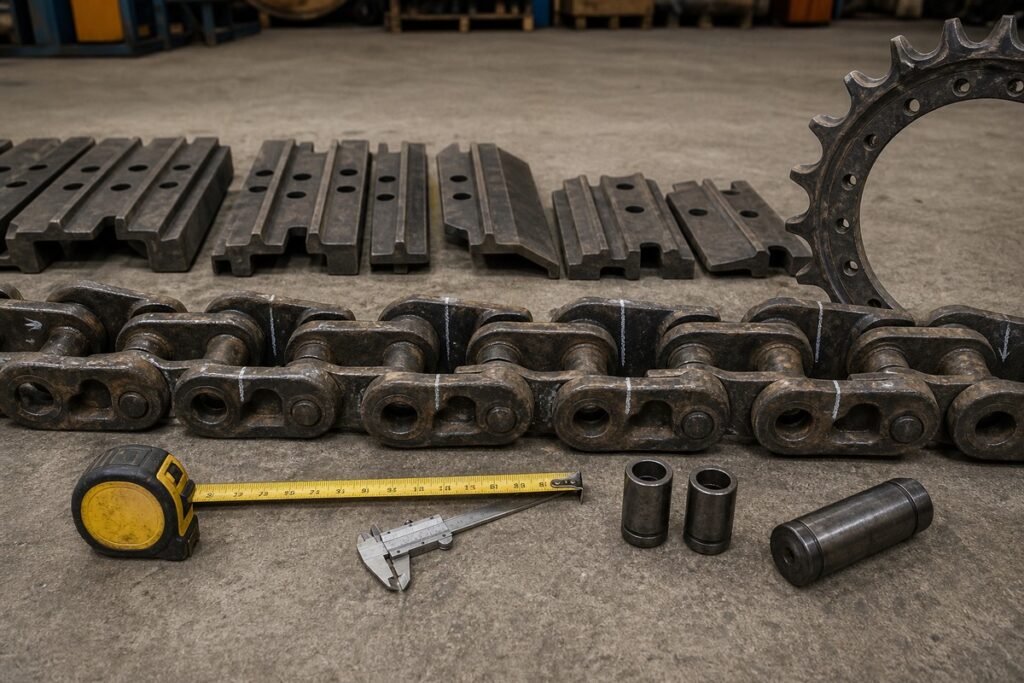
Looking for an excavator track chain? Send PRIMA your machine model or a part photo and tell us whether you need an individual link, a bare chain, or a chain assembled with track shoes. We prioritize new genuine undercarriage parts; the proposed item’s source, fitment, quantity and availability need confirmation for your order.
Link count, pitch and the shoe mounting pattern matter alongside the full machine model and serial information. A familiar model name is a starting point, not approval to fit any chain carrying that label. Start an enquiry with what you have; missing measurements can be clarified before an order.
Ask about a track chain · Genuine undercarriage parts
Specify the assembly and the quantity per side
“Track link”, “track chain” and “complete track assembly” can describe different purchases. Make the quotation identify the physical item and what is included, not just a model and a price.
| Requested item | State explicitly in the quote |
|---|---|
| Individual track link | Exact link part number, left/right design where applicable, quantity and any pins or bushings included. A single link is not a complete chain. |
| Bare track chain | Links per chain, nominal pitch, joint type and whether connecting components are included. Track shoes and mounting hardware must not be assumed. |
| Chain with track shoes | Chain specification, shoe width/type, shoe bolt pattern, bolt/nut inclusion and whether shoes are assembled or supplied separately. |
| One side or both sides | Number of chains for each side and total quantity. Do not use “one set” without explaining the count and contents. |
Rubber tracks are a different product and should not be substituted for a steel track-chain request. If you only need shoes, use our track shoe width and mounting checklist.
Record link count, pitch and shoe dimensions
Use existing part records and safely accessible photographs first. A qualified technician should handle any lifting, track movement, tension release or removal under the machine manufacturer’s procedures. Do not work near moving tracks or beneath unsupported equipment to obtain a quotation photo.
- Machine identity: record the complete model suffix and serial information, plus any known undercarriage changes. A CAT 320C, 320D or another 320-series designation is not a universal chain specification.
- Link count: mark a starting point and record the count once around the chain when safely accessible. Include photos explaining what was counted and identify the side. Do not copy the count from a generic listing.
- Pitch: record pin-center to pin-center measurement points and units. Measuring across several intervals can help a technician review a worn chain, but wear can increase the reading; it is not automatically the nominal pitch for the new part.
- Shoes and mounting: record shoe width, grouser type, bolt-hole arrangement and spacing. Include a readable scale and state millimetres or inches. Confirm the approved specification rather than selecting a wider shoe from appearance alone.
- Part reference: photograph readable markings and compare the proposed part number with the applicable machine/parts reference. Record any superseding number and the basis for the match.
Illustrative mismatch, not a customer case: if a machine requires a 53-link chain, a quoted 51-link chain is a discrepancy that must be resolved before ordering. These numbers are hypothetical examples, not specifications for any model. Link count alone also does not establish the correct pitch, mounting or joint design.
For a broader evidence checklist, see excavator parts fitment checks. For CAT requests, keep the exact configuration in the CAT undercarriage discussion; no brand-level page replaces item-specific confirmation.
Check the chain together with the rest of the undercarriage
Ask a technician to inspect sprocket tooth condition, idler alignment, roller condition and the existing chain before deciding the replacement scope. A photograph can identify questions to investigate, but cannot establish hidden wear, hardness, sealing condition or remaining service life.
- Sprocket checks: compare the chain specification and tooth profile; resolve visible hooking or poor engagement.
- Idler checks: review guidance, alignment and the applicable tensioning arrangement.
- Track roller checks: identify the correct guide arrangement and condition along each side.
This system review does not mean every component must be replaced. Use measured condition and the relevant manufacturer limits to decide what belongs in the quotation.
Verify genuine origin separately from fitment
For a new genuine track-chain request, ask for the proposed brand and part number, actual item and packaging photographs, readable markings and available source documentation. “OEM reference”, a copied number or a compatible-model list is not by itself evidence that the offered item is genuine.
Check new condition, the declared joint/sealing type and the exact contents separately. Any alternative must be identified as an alternative before you choose it. PRIMA is an independent supplier; descriptive brand names do not mean authorized-dealer status or confirm that a part is in stock.
The part-number verification guide explains why source identity, condition and fitment need their own evidence.
Before payment and shipment, agree the item-specific record
- Fitment: written part reference, links per chain, pitch, joint design, shoes and mounting details as applicable, with unresolved differences clearly identified.
- Quantity: one side or both sides, chain and shoe quantities, hardware and assembly work included or excluded.
- Commercial scope: current availability, preparation/dispatch estimate, applicable warranty provider, period, coverage and claim requirements. This guide is not an hours-based warranty or stock guarantee.
- Packing and freight: agreed protection and securing, packed dimensions/weight, quantities and photographs matched to the quote, destination and transport scope. A parcel-rate estimate is not a confirmed sea-freight quote.
Ask PRIMA about your track chain
Start with your model or a part photo, what you need and a reply contact. Add the quantity for each side and delivery country if known. You do not need a complete measurement file for a first enquiry; final supply and fitment still require confirmation.
Track chain buying questions
These answers distinguish an initial enquiry from the checks needed to approve an order.
Is a track link the same as a complete track chain?
No. A track link can be an individual component. A bare chain and a chain assembled with shoes have different contents. State the part, quantity per side and included hardware explicitly.
Is the excavator model enough to order a chain?
No. Use the full model and serial information together with the part reference, link count, pitch, mounting and joint details. Existing undercarriage changes or wear can make a generic listing or old measurement misleading.
Can I contact PRIMA before measuring everything?
Yes. Start with your model or a part photo, your requirement and a reply contact. Missing information can be clarified before an order; an enquiry does not confirm stock or fitment.
Technical background
Caterpillar’s undercarriage overview provides manufacturer background on system options and service support; its product claims and warranties apply to its own offers, not automatically to PRIMA. The UK HSE excavator safety guidance is general safety reading, not a chain-fitting procedure. Follow the instructions for the actual machine.