
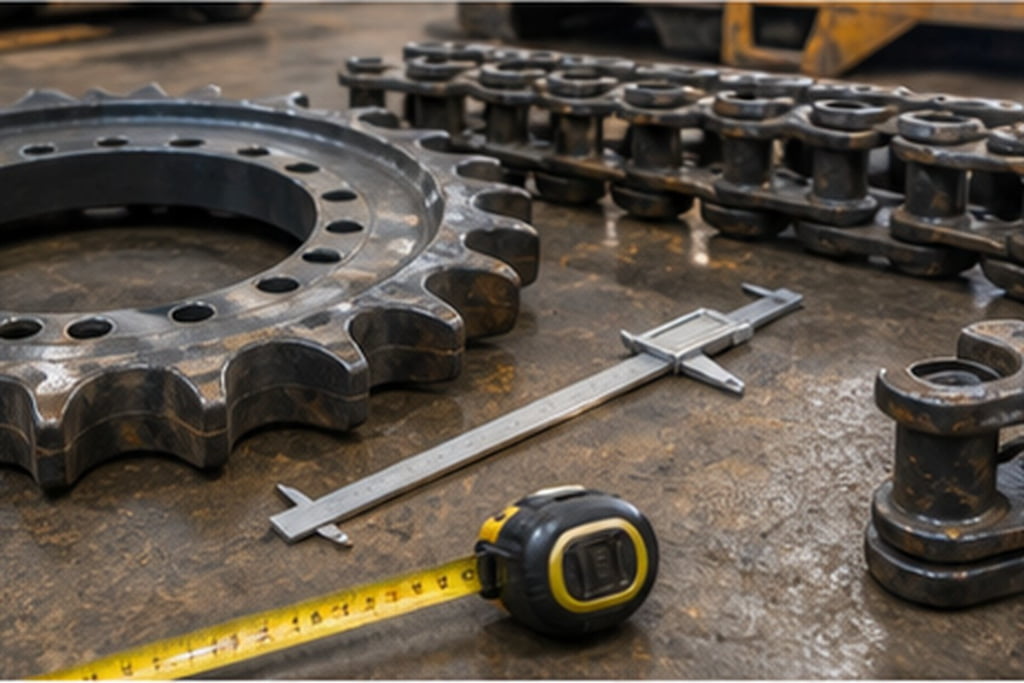
Ask PRIMA about new genuine excavator sprockets. Send your machine model or a part photo and tell us whether you need a full sprocket wheel, an individual segment or a complete segment set. Source, fitment, quantity and current availability need confirmation for the proposed item before an order.
Ask about a sprocket. Start with the information available; you do not need a complete measurement file for a first enquiry.
Excavator sprockets are high-risk undercarriage parts because they must match the track chain. A hooked sprocket, stretched chain or wrong pitch can create early wear even when the new part is well made. This page supports the undercarriage parts guide, the track-chain fitment guide and the excavator parts supplier guide.
Buyer Summary
- Sprocket quotation should confirm tooth wear, chain pitch, segment type, bolt pattern and hub dimensions.
- A sprocket should be evaluated with track chain, idler and roller condition, not as an isolated part.
- Segment sprockets and full sprockets require different photo and measurement evidence.
- Packing should protect teeth, bolt holes and machined surfaces during export shipment.
Information for a sprocket quote
The buyer should send machine identity, old-sprocket photos, tooth count or segment details, bolt pattern, chain pitch and destination.
A sprocket can be a full wheel or segmented set, and the same excavator family may have variations in bolt pattern, hub, tooth profile or chain match. Buyers should send photos from the side, face and mounting area. For a segmented sprocket, show safely accessible bolt-pattern and segment-shape details; use photos of a removed segment only if it is already available. Qualified technicians must handle lifting, track movement or removal under the machine manufacturer’s procedures. Do not enter the track path of an operating machine to collect photos.
State whether you need one side, both sides or a wider undercarriage set, with the total wheel or segment quantity and hardware included. If the old chain is badly worn, a new sprocket alone may not last. A strong quote connects the sprocket option with chain condition, roller condition and idler alignment.
| Data | Evidence | Why it matters |
|---|---|---|
| Sprocket type | Full wheel or segment photos | Avoids wrong structure |
| Mounting | Bolt pattern and hub photos | Prevents installation failure |
| Chain match | Pitch and chain wear evidence | Controls early wear |
How to judge sprocket tooth wear and chain pitch mismatch
Hooked, sharp, thin or uneven teeth can show chain mismatch, stretched chain or long service wear.
A worn sprocket may have hooked teeth, uneven side wear, sharp tooth tips or a narrowed profile. If the track chain pitch has changed due to wear, the sprocket and chain no longer mesh smoothly. Replacing only the sprocket may create noise, vibration or rapid wear on the new component.
Buyers should photograph the sprocket teeth with enough side detail, and also send chain pitch and link-count evidence when possible. PRIMA can then advise whether the sprocket can be quoted alone or whether chain, idler and roller condition should be reviewed together.
| Wear sign | Possible issue to inspect | Quote response |
|---|---|---|
| Hooked teeth | Worn chain or long service | Check chain pitch |
| Side wear | Alignment or track-frame issue | Check idler/roller path |
| Broken tooth | Impact or severe wear | Inspect surrounding parts |
How segment type, bolt pattern and hub dimensions affect fitment
Segmented sprockets need segment shape and bolt pattern proof; full sprockets need hub and mounting dimensions.
Some excavators use sprocket segments bolted around the drive hub, while others use a full sprocket. Segment count, bolt-hole spacing, tooth count and segment curve must match. For full sprockets, hub diameter, bore, thickness and mounting face are more important. Photos should show the mounting side, not only the worn tooth side.
Keep the measurement record with the quotation and resolve mounting differences before approving an order. A wrong bolt pattern can make an otherwise correct-looking sprocket impossible to install.
| Sprocket form | Evidence needed | Main risk |
|---|---|---|
| Segment type | Segment shape and bolt spacing | Wrong segment set |
| Full sprocket | Hub, bore and face dimensions | Cannot mount |
| Mixed old parts | Actual photos from both sides | Previous nonstandard repair |
How sprocket, track chain, rollers and idlers should be checked together
The sprocket is part of the undercarriage system, so chain, roller and idler evidence should support the final choice.
If the track chain is stretched, the new sprocket may wear quickly. If rollers or idlers are seized, the chain path can load the sprocket unevenly. If track tension is incorrect, tooth engagement can suffer. Buyers should show the full undercarriage condition before asking PRIMA to confirm only the sprocket.
This does not mean every order must include a complete undercarriage set. Have a qualified technician use measured condition and manufacturer limits to decide the replacement scope; photographs alone cannot diagnose the cause or predict service life.
| Related part | Check | Effect on sprocket |
|---|---|---|
| Track chain | Pitch, link count, bushing wear | Tooth engagement |
| Idler | Alignment and tension | Chain path |
| Rollers | Seized or uneven wear | Load distribution |
Confirm new genuine origin and quotation contents
Review actual item and packaging photos, readable part markings and available source documentation. A compatible-model list, copied part number or “OEM quality” label does not by itself prove genuine origin. PRIMA is an independent supplier; brand names are not an authorized-dealer claim.
State tooth count, applicable chain pitch, mounting pattern and hub details for the proposed item. For segments, list the number and type of segments per side and whether bolts are included; for full wheels, clarify hub and fastener inclusions. Confirm new condition and any alternative separately. See part-number and source verification.
Current availability, dispatch estimate, warranty provider, coverage and exclusions must be agreed for the quotation. This guide is not a stock list, universal fitment table or service-life guarantee.
How PRIMA packs sprockets and confirms shipment evidence
Sprocket teeth and machined faces should be protected so the part arrives ready for installation.
Sprockets are heavy enough to damage crates or other parts if they shift in transit. Teeth, bolt holes and mounting faces should be protected from impact and rust. Segment sets should be kept together and photographed as a complete set before packing.
Before shipment, PRIMA can provide actual-part photos, dimension confirmation, crate photos, labels and document match. This evidence helps dealers and repair shops verify that every sprocket or segment set belongs to the correct machine after arrival.
| Packing item | Proof | Buyer value |
|---|---|---|
| Teeth protection | Padding and separation | Prevents impact damage |
| Segment grouping | Complete-set photo | Avoids missing pieces |
| Shipment match | Labels and packing list | Simplifies receiving |
Evidence Table
Use the following evidence to compare the proposed sprocket with the machine and the agreed shipment scope.
| Buyer question | Evidence to review | Value |
|---|---|---|
| Which sprocket fits? | Old-sprocket photos, bolt pattern and hub dimensions | Prevents mounting mismatch |
| Will it match the chain? | Pitch, link count and chain wear evidence | Reduces rapid wear |
| Can segments ship complete? | Set photos, crate photos and labels | Avoids missing pieces |
Ask PRIMA about your sprocket
Send your model or part photo, the item you need and a reply contact. Quantity per side and delivery country help us clarify the next checks; missing measurements can be confirmed before an order.
Buyer FAQ
These answers explain the item scope and checks needed before an order.
Should I replace sprocket and track chain together?
Not always, but chain pitch, link wear and sprocket tooth wear should be checked together before deciding.
What photos should I send for a sprocket quote?
Send machine serial plate, old sprocket from both sides, tooth close-up, bolt pattern, hub area and track-chain condition.
Is a sprocket segment the same as a full sprocket?
No. A segment is one bolted section of the sprocket ring, while a full sprocket is a complete wheel or assembly.
Conclusion
Excavator-sprocket sourcing should confirm tooth wear, chain match, bolt pattern and export packing as one evidence file. PRIMA can reduce wrong-part and early-wear risk by checking the undercarriage system before final quotation.
References
- CAT undercarriage reference: General undercarriage-system reference.