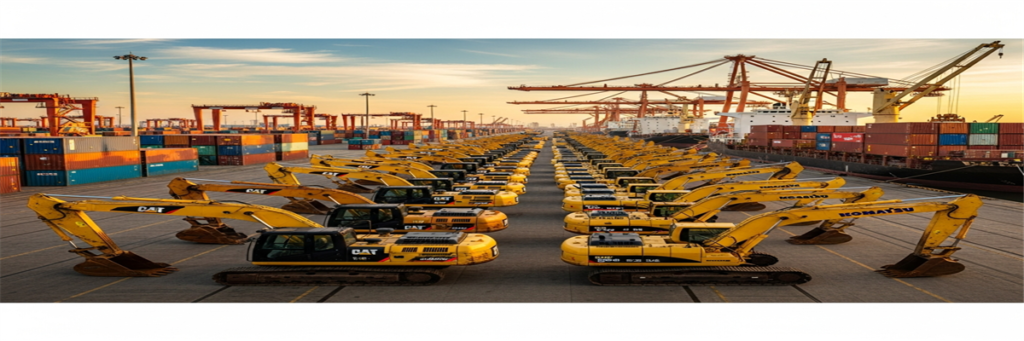
Africa’s construction sector is undergoing a massive transformation. With over $300 billion in infrastructure projects currently underway or planned across the continent, the demand for reliable, cost-effective heavy machinery — particularly used excavators — has reached unprecedented levels in 2026.
The Infrastructure Boom Driving Demand
From Nigeria’s Lagos-Calabar Coastal Highway to Kenya’s Nairobi Expressway expansion, from Egypt’s New Administrative Capital to Tanzania’s Standard Gauge Railway — Africa is building at a pace not seen in decades. The African Development Bank estimates that the continent’s infrastructure financing needs range between $130 billion and $170 billion annually, with a current gap of $68 billion to $108 billion.
This unprecedented construction activity has created a surge in demand for excavators, loaders, and earthmoving equipment. However, the cost of brand-new machinery from manufacturers like Caterpillar, Komatsu, and Hitachi remains prohibitive for many contractors and dealers operating in these emerging markets.
Why Used Excavators Are the Smart Choice
The economics are compelling. A new CAT 320 excavator can cost upward of $150,000–$200,000, while a quality-inspected used unit with 3,000–6,000 working hours can be acquired for 40–60% less — delivering the same job-site performance at a fraction of the investment.
For contractors in Africa, the Middle East, and Southeast Asia, this cost advantage translates directly into:
- Lower project costs — Reduced capital expenditure means more competitive bidding on government and private contracts.
- Faster fleet expansion — Dealers can stock more machines per dollar invested, serving more customers across wider territories.
- Proven reliability — Japanese and American-made excavators (Komatsu, Hitachi, CAT, Volvo) are engineered for 15,000+ hour lifespans. A machine with 5,000 hours still has decades of productive work ahead.
- Readily available parts — The global aftermarket for popular models like the Komatsu PC200 and CAT 320 ensures spare parts are accessible worldwide.
China’s Role as the Global Hub for Used Excavator Exports
China has emerged as the world’s largest marketplace for used construction equipment. With its domestic infrastructure boom maturing and a massive fleet of well-maintained machines becoming available, Chinese exporters are uniquely positioned to meet global demand.
Key advantages of sourcing used excavators from China include:
- Unmatched inventory diversity — Chinese yards stock all major brands: CAT, Komatsu, Hitachi, Volvo, Doosan, Kobelco, SANY, and XCMG, across tonnage classes from 6-ton mini excavators to 50-ton heavy-duty units.
- Competitive pricing — Direct yard access eliminates middlemen. Buyers get genuine wholesale B2B prices that protect their resale margins.
- Established logistics — China’s port infrastructure (Shanghai, Tianjin, Guangzhou) offers efficient Ro-Ro, flat rack, and container shipping to every major African and Middle Eastern port.
- Quality Chinese brands — Domestic manufacturers like SANY and XCMG have dramatically improved quality. Their used machines now compete with Japanese brands on reliability while offering an even lower price point.
Key Markets to Watch in 2026
East Africa: Tanzania, Kenya, Ethiopia
The East African Community continues to invest heavily in transport corridors and urban development. Tanzania’s $2.2 billion Julius Nyerere Hydropower Project and Ethiopia’s industrial park expansion program are driving sustained demand for 20–30 ton class excavators.
West Africa: Nigeria, Ghana, Senegal
Nigeria alone accounts for over 30% of Sub-Saharan Africa’s construction output. The Lagos-Calabar Coastal Highway, Lekki Deep Sea Port operations, and Dangote Refinery auxiliary projects require continuous earthmoving equipment deployment.
Southeast Asia: Indonesia, Vietnam, Philippines
Indonesia’s new capital city Nusantara project, Vietnam’s North-South Expressway, and the Philippines’ Build Better More program are generating massive equipment demand. Used excavators from China offer these markets the best value proposition due to proximity and established shipping lanes.
Middle East: Saudi Arabia, UAE, Iraq
Saudi Arabia’s NEOM and Vision 2030 mega-projects continue to absorb construction equipment at an extraordinary rate. While premium new machines serve the flagship sites, the broader contractor ecosystem relies heavily on quality used equipment for supporting infrastructure work.
How to Source Quality Used Excavators: A Buyer’s Guide
Not all used excavators are equal. The difference between a profitable purchase and a costly mistake lies in the sourcing process. Here’s what experienced buyers look for:
1. Inspect Before You Buy
Never purchase based on photos alone. Request live video inspections via WhatsApp or similar platforms. Watch the engine cold-start, observe hydraulic response times, check for unusual smoke or noise, and verify undercarriage condition.
2. Verify Working Hours
The hour meter is your most important data point. Machines under 6,000 hours typically offer the best balance of remaining life versus price. Be cautious of tampered meters — experienced exporters can verify hours through ECU diagnostics.
3. Check the Frame and Undercarriage
Cosmetic paint can hide structural issues. Insist on unpainted frame photos. Check for cracks, welds, and alignment issues. The undercarriage alone can cost $15,000–$25,000 to replace, so its condition dramatically affects the machine’s true value.
4. Choose a Transparent Supplier
Work with exporters who refuse “fake renovations” — those who show machines as-is with honest descriptions. A trustworthy supplier provides real photos, real videos, and real condition reports rather than studio shots of freshly painted machines hiding underlying problems.
The Outlook: Strong Growth Ahead
Industry analysts project the global used construction equipment market will grow at a CAGR of 6.2% through 2030, with Africa and Southeast Asia leading demand growth. Several factors support this trajectory:
- Urbanization — Africa’s urban population is expected to double by 2050, requiring massive housing and infrastructure development.
- Government spending — Multilateral financing from the World Bank, African Development Bank, and China’s Belt and Road Initiative continues to fund large-scale projects.
- Cost pressures — Rising new equipment prices and supply chain constraints make used machinery increasingly attractive.
- Sustainability — Reusing well-maintained equipment extends its productive life and reduces the environmental footprint of manufacturing new machines.
Conclusion
The convergence of Africa’s infrastructure ambitions, China’s equipment surplus, and proven cost economics makes 2026 an exceptional year for the used excavator export market. For dealers, contractors, and fleet operators seeking to capitalize on this opportunity, the key is finding a reliable sourcing partner who combines genuine inventory, honest inspections, competitive pricing, and end-to-end logistics support.
As Africa builds its future, used excavators from China will play an increasingly vital role — delivering the performance these projects demand at a price point that makes them possible.
