
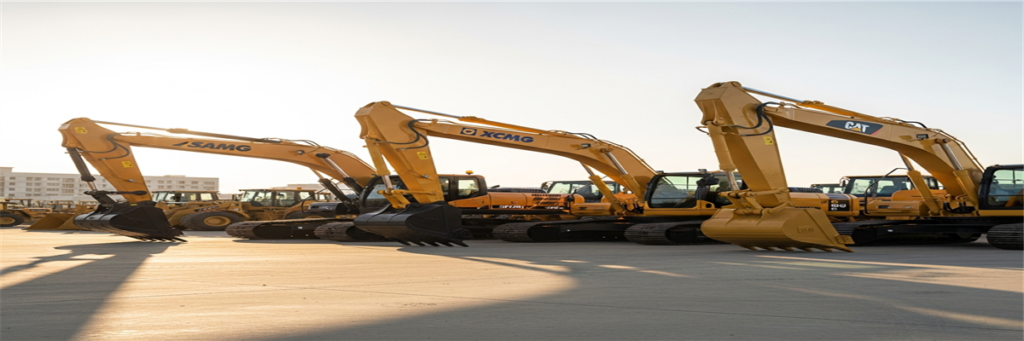
Chinese and Japanese excavators cannot be ranked reliably by nationality alone. For a used-equipment buyer, the stronger purchase is the exact machine with the better job fit, verified condition, support route, transport plan and landed-risk file.
Brand headquarters, manufacturing location, market configuration and current used condition are separate facts. A Japanese-brand machine may have been built or operated in China; a Chinese-brand machine may have a destination-specific configuration or dealer route. The serial/PIN and machine evidence—not the label—must control the decision.
Chinese vs Japanese excavator buyer matrix
| Comparison layer | Evidence for both candidates | Do not assume |
|---|---|---|
| Identity | Serial/PIN, model, generation, engine/emissions labels and production context | Brand nationality proves manufacturing origin |
| Job fit | Boom, arm, bucket, tracks, guards, attachment and buyer work profile | Same ton class means same capability |
| Condition | Cold start, hydraulics, travel, swing, wear, leaks, history and repair evidence | Country or brand proves remaining life |
| Support | Destination diagnostic capability, current parts route, lead time and warranty issuer | A global logo guarantees local support |
| Landed risk | Repairs, transport, documents, compliance, receiving and downtime allowance | Purchase price equals total cost |
Separate brand, origin and exact-machine condition
Record the machine’s model plate, serial or PIN, engine and emissions labels, hour-meter context, monitor and major component labels where safely visible. Confirm the model generation and market configuration using matching manufacturer or parts information. Do not infer production location or component origin from a brand name.
Manufacturer pages illustrate configuration differences. SANY’s official medium excavator range lists multiple variants within a model family. The official XCMG XE215DA page describes one named product. These references do not establish the condition of a used unit.
| Fact | Best evidence | Decision affected |
|---|---|---|
| Brand and model | Machine plate and serial/PIN context | Correct product family |
| Generation and market | Labels plus matching manufacturer/parts reference | Engine, emissions, controls and support |
| Installed configuration | Measured working equipment, tracks, guards and options | Job fit and shipping |
| Current condition | Identity-linked inspection and history | Repair and downtime risk |
Compare the job before comparing the machines
Define material, reach and depth, loading height, lifting needs, attachment, ground conditions, duty cycle, fuel/emissions constraints, transport limits, operator experience and acceptable downtime. Then verify that each exact configuration can serve the required work under the applicable manufacturer limits.
A machine with attractive brochure figures can still be unsuitable because of boom/arm choice, track width, attachment plumbing, ground pressure, transport width or emissions package. Do not copy a maximum figure without the stated configuration and test standard.
Use one condition test for both used excavators
Cold start and engine
Request one continuous first-start record tied to the serial-area view, including dashboard, startup behavior, smoke, sound, visible leaks and warnings. Record engine response when hydraulic functions are operated. A pre-warmed or edited demonstration reduces confidence.
Hydraulics, swing and travel
Record boom, arm, bucket, swing, straight travel, turns and available speed modes under the same safe conditions. Note drift, weakness, heat, abnormal sound and leaks. One symptom is not proof of a pump, valve, cylinder or motor failure.
Undercarriage, structure and attachments
Compare both sides of the undercarriage using a stated measurement method. Inspect frame, boom and arm areas, welds, pin and bushing play, cylinder rods, bucket linkage, coupler, teeth and the exact included attachment. Unsupported wear percentages should not receive the same score as measurements.
Use the used excavator inspection checklist for both machines. If the comparison involves specific models, use a model-level owner such as the Komatsu PC210 vs Hitachi ZX210 evidence file instead of stretching nationality-level conclusions.
Verify parts and service at the destination
Ask who can diagnose each exact generation, what manuals/tools are available, how routine and wear parts are sourced and how major hydraulic, travel, engine or electrical components will be matched. Record provider, location, current lead time, condition class, warranty issuer and exclusions.
Use PRIMA’s supplier evidence guide and brand-specific parts owners. A website category, dealer-network headline or logo does not prove local inventory, fitment, genuine status or warranty acceptance for the exact machine.
| Support question | Evidence | Risk if missing |
|---|---|---|
| Can the exact generation be diagnosed? | Named provider, location and current capability | Trial-and-error repair |
| Can routine/wear parts be obtained? | Current local or supplier quote | Maintenance interruption |
| Can major components be matched? | Serial, component label and part-number basis | Wrong part or long downtime |
| Who issues the warranty? | Legal issuer, territory, term and claim procedure | No usable remedy |
Compare transport, import and landed risk
Use measured or verified dimensions and weight for each exact configuration. Working equipment, track width, guards and counterweight can change dismantling, inland transport, container or flat-rack planning, loose parts and reassembly.
Apply the used excavator shipping checklist and import-control guide. Destination eligibility, importer responsibility, engine/emissions evidence and documents must be verified independently for both machines.
Build the weighted exact-machine decision file
| Category | Score basis | Commercial adjustment |
|---|---|---|
| Identity and job fit | Verified / partial / unresolved | Configuration correction or reject |
| Mechanical condition | Tested / limited / untested | Inspection, repair and downtime |
| Wear and structure | Measured / photographed / unclear | Wear-parts and structural allowance |
| Parts and support | Current route / limited / unknown | Lead-time and downtime allowance |
| Logistics and compliance | Verified / estimated / incomplete | Transport, clearance and receiving |
Set weights for the buyer’s actual work. Keep source photos, reports, measurements, quotations and unresolved exceptions behind each score. The first-90-days guide can be used to compare operating readiness after arrival.
Buyer FAQ
Are Japanese excavators always more reliable?
No universal used-machine conclusion is supported by nationality. Reliability risk depends on exact design/configuration, application, maintenance, repairs, contamination, wear and current condition.
Are Chinese excavators always cheaper?
No. Price depends on exact brand/model, generation, condition, hours/history, configuration, seller, location, repairs, support and transport. Compare written landed scenarios, not a universal percentage.
Can two excavators be compared from brochures alone?
No. Match generation, market, emissions package, boom, arm, bucket, undercarriage and test standard, then add used-condition evidence.
Does PRIMA claim manufacturer authorization?
No. Brand and model names are descriptive. Authorization, certified-used status, genuine parts and manufacturer warranty require evidence from the actual issuer.
Limitations
PRIMA does not declare a universal Chinese or Japanese winner and does not claim manufacturer authorization, certified-used status, fixed price, durability, resale value, fuel use, local support, warranty or fitness for a job. The exact machine, destination, inspection and written contract control the purchase.
Official references
- SANY official medium excavator range — configuration variation within a product family.
- XCMG official XE215DA page — one named product reference.
- Komatsu official PC210LC-11 page — one regional/configuration reference.
- Hitachi official used-equipment program — manufacturer-backed used-equipment context.