
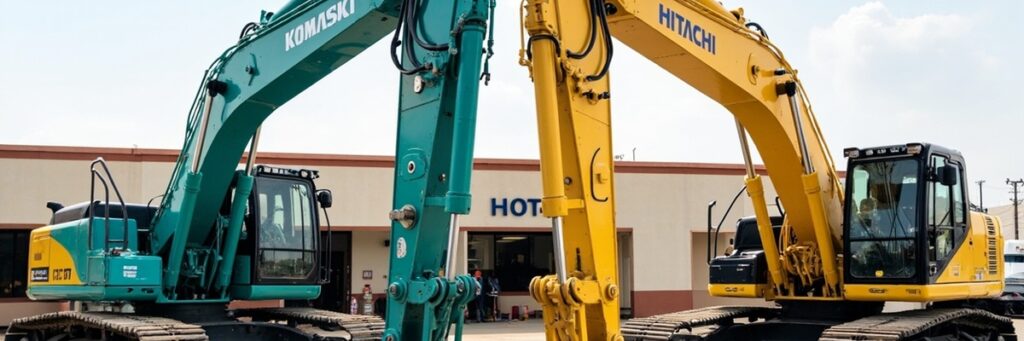
Choose between a used Komatsu PC210 and Hitachi ZX210 by comparing the exact machines, not by declaring one badge universally better. Match generation and regional configuration, verify condition with the same test sequence, price the wear and repairs, confirm local parts and service support, and compare transport and landed risk.
Buyer Summary: Build two parallel evidence files and use one scoring method. A lower asking price is not better value when identity, hydraulics, undercarriage, repairs, parts or shipping remain uncertain.
Why do PC210 and ZX210 model names hide important differences?
Both names cover model generations and regional configurations. Engine and emissions equipment, boom and stick, track frame and shoe width, counterweight, cab and guards, auxiliary hydraulic circuits, bucket and digital systems can differ. Official manufacturer pages are useful for identifying a stated configuration, but they should not be copied onto an older or different-market used machine.
For each candidate, save the serial or PIN area, model plate, engine and emissions labels, hour meter, monitor startup, boom and stick markings, track width, bucket and auxiliary lines. Ask the seller to identify the sales region and generation when documented. Unknown information should remain marked unknown.
| Identity item | Komatsu file | Hitachi file | Decision effect |
|---|---|---|---|
| Model and generation | Exact PC210/PC210LC suffix and serial context | Exact ZX210/ZX210LC suffix and serial context | Avoids comparing unlike variants |
| Configuration | Boom, stick, tracks, bucket, guards and auxiliary lines | Boom, stick, tracks, bucket, guards and auxiliary lines | Confirms job and transport fit |
| Engine/emissions | Label and region evidence | Label and region evidence | Supports compliance and parts review |
How should both excavators be tested on the same basis?
Use the same evidence request, safe test conditions and rating scale. Begin with a true cold start, monitor and warning screen, exhaust and engine sound. After warm-up, record boom, arm and bucket movement, simultaneous functions, swing start and stop, travel in both directions, turns, braking and visible leaks. Note ambient and ground conditions because they affect what the video can show.
Do not treat video speed as a precise hydraulic measurement. If one machine is filmed warm, unloaded and on firm ground while the other is filmed cold or under load, the result is not comparable. Request clarification or a repeated test rather than awarding a score.
Use PRIMA’s Komatsu used excavator inspection guide and Hitachi used excavator inspection guide to keep the evidence categories parallel.
| Test | Record for both machines | Comparison question |
|---|---|---|
| Cold start | Startup sequence, smoke, sound, leaks and warnings | Which file has fewer unresolved engine risks? |
| Hydraulics and swing | Function video, drift, cylinder rods, hoses, noise and play | Which condition is better supported, not merely faster on video? |
| Travel | Straight travel, turns, both speeds when available and final-drive views | Are weak travel, noise or leakage risks priced? |
How should undercarriage, structure and attachment wear be compared?
Request the same close views and measurements for left and right track chains, pins and bushings, shoes, rollers, carriers, idlers and sprockets. Record track tension, guards, frame condition and uneven wear. Use a stated reference and method when a wear percentage is supplied; an unsupported percentage should not receive the same score as measurements.
Compare boom, arm and frame welds, pin and bushing play, bucket linkage, coupler, teeth, adapters and included attachment. A machine with a better powertrain file can still be the weaker purchase if structural work, undercarriage replacement or an unsuitable attachment changes the landed budget.
What parts and service evidence matters after arrival?
Local support depends on the exact generation, serial range, installed components and destination network. Ask which diagnostic access, manuals, filters, wear parts, hydraulic components, final drives and undercarriage items can be supported. Keep current availability and lead time quote-specific; a general parts page is not stock proof.
For Komatsu, review the Komatsu excavator parts buyer guide. For Hitachi hydraulic risk, use the Hitachi hydraulic pump buyer guide. Any genuine, OEM, rebuilt, warranty or certified claim must name the issuing party and exact item.
| Support question | Evidence | Boundary |
|---|---|---|
| Can the exact variant be identified? | Serial context, part numbers, labels and component photos | Model family alone is insufficient |
| Can routine and wear parts be sourced? | Current quote or local supplier confirmation | Website categories do not prove stock |
| Can major repairs be supported? | Diagnostic route, workshop capability and warranty terms | Verbal confidence is not a repair plan |
How should shipping and landed risk change the comparison?
Compare measured or verified transport dimensions and weight for each exact configuration. Track width, boom and stick, bucket, guards and counterweight can change dismantling, inland transport and ocean-freight plans. Record removed components, protected hydraulic openings, loose-part packing and reassembly responsibility.
Use the used excavator shipping checklist. Build landed scenarios that include machine price, agreed repairs, inland handling, loading, freight, insurance, destination charges, duties or taxes, broker cost, receiving and a contingency for unresolved wear. Do not select the winner from purchase price alone.
Weighted comparison file
| Category | Suggested evidence score | Cost adjustment |
|---|---|---|
| Identity and configuration | Complete / partial / unresolved | Compliance, job-fit and transport correction |
| Engine and hydraulics | Tested / limited / not tested | Inspection, repair and downtime allowance |
| Undercarriage and structure | Measured / photographed / unclear | Wear-parts and structural repair allowance |
| Parts and service | Current route / limited route / unknown | Lead-time and downtime allowance |
| Shipping and documents | Verified / estimated / incomplete | Freight, handling and clearance allowance |
The category weights should reflect the buyer’s work and destination. A quarry, rental fleet, road contractor and occasional owner may value configuration, fuel/emissions system, attachment, dealer support and downtime differently. Preserve the evidence behind every score so the decision can be reviewed later.
Buyer FAQ
Is a Komatsu PC210 always better than a Hitachi ZX210, or vice versa?
No. The better purchase is the exact machine with the stronger verified condition, configuration fit, service evidence, parts route, transport plan and landed-cost case.
Can buyers compare two machines using model specifications alone?
No. Specifications identify a configuration, not used condition. Buyers should compare serial and regional variants, hours and history, cold-start and operating tests, wear measurements, repairs, attachments and support evidence.
Why do regional and generation details matter?
Engine and emissions equipment, boom and stick, track width, options, controls and support arrangements may differ by generation and market. These differences affect compliance, job fit, parts and shipping.
Does PRIMA claim official Komatsu or Hitachi authorization?
No. The brand and model names are used descriptively. Official dealer, certified-used, warranty and genuine-parts claims require evidence from the actual issuing organization.
Limitations
PRIMA does not declare a universal winner and does not claim Komatsu or Hitachi authorization, certified-used status, current stock, fixed specifications, warranty or fitness for a job. Official pages below describe particular manufacturer programs or configurations; the exact used-machine evidence controls the purchase decision.
Official references
- Komatsu PC210LC-11 product page — an official regional configuration reference, not a universal specification for every PC210.
- Hitachi ZX210LC-7 product release — an official generation/market reference, not proof about a particular used ZX210.
- Hitachi global used-equipment program — an official example of inspection and maintenance standards used in a manufacturer-backed program.