
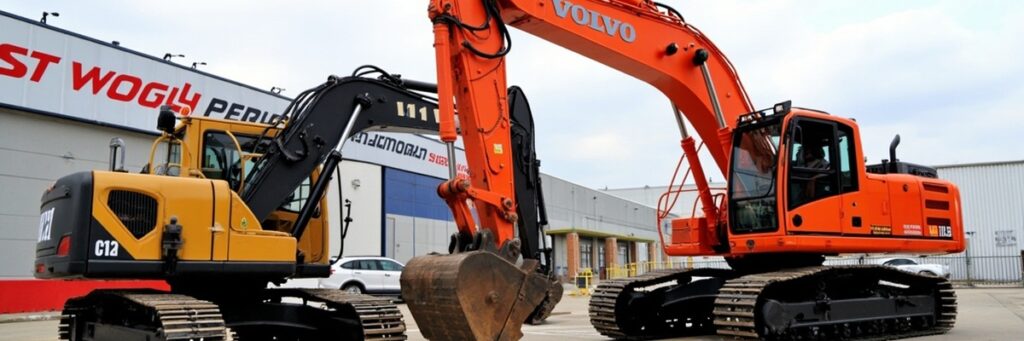
A used SANY excavator is not automatically better value than a used Volvo excavator, and a used Volvo is not automatically the safer purchase. The better choice is the exact machine with the stronger match for the buyer’s work, verified condition, parts and service route, transport plan and landed-risk case.
Brand reputation and model brochures can help create a shortlist. They do not prove the configuration, wear, maintenance, remaining life or support available for a particular used excavator. Build one exact-machine comparison file and score both candidates with the same evidence standard.
SANY vs Volvo buyer decision table
| Decision gate | Evidence for both machines | Reject or hold when |
|---|---|---|
| Identity and configuration | Serial/PIN, model and generation, engine/emissions labels, boom, arm, bucket, tracks and options | The listing cannot be tied to one exact machine |
| Job fit | Material, reach/depth, lifting, attachment, ground conditions and operating environment | The configuration is unsuitable or unverified |
| Condition | Cold start, monitor, hydraulics, travel, swing, leaks, wear measurements and repair history | Critical functions are untested or evidence is edited/incomplete |
| Support | Local diagnostic capability, manuals, current parts route, lead times and warranty issuer | A claim has no exact provider, part or location evidence |
| Landed risk | Repairs, loading, freight, documents, destination compliance, receiving and contingency | Purchase price is presented as total cost |
Compare exact identity before specifications
Record the serial or PIN area, model designation, generation, production context, engine and emissions labels, hour-meter context, installed pump and major component labels where safely visible. Also record boom and arm, bucket, coupler, auxiliary lines, track width, shoe width, guards, cab protection and counterweight.
Official manufacturer pages illustrate why this matters. SANY’s medium excavator range lists several SY215 variants with different weights, power and bucket configurations. Volvo CE’s EC220 page describes a stated market and configuration and notes that features can vary by market and model. Neither page proves the specification of a used machine offered elsewhere.
| Identity field | Why it changes the comparison | Acceptable evidence |
|---|---|---|
| Generation and market | Engine, emissions, controls, options and documentation may differ | Machine labels plus matching manufacturer or parts reference |
| Working equipment | Reach, digging behavior, transport size and job fit change | Measured or verified boom, arm, bucket and attachment record |
| Undercarriage | Stability, ground pressure, wear cost and shipping width change | Track configuration, shoe width and wear evidence |
| Installed components | Parts and repair routes depend on exact fitment | Clear component labels, serial context and part numbers |
Match the excavator to the buyer’s real work
Write the job before scoring the machine: material, trench or bench dimensions, loading height, lifting needs, attachment, ground conditions, duty cycle, fuel and emissions rules, operator skills, transport limits and acceptable downtime. A configuration that is attractive for general earthmoving may be wrong for quarry work, soft ground, restricted urban space or a specialized attachment.
Do not copy a brochure’s maximum figure into the buying file without the stated boom, arm, bucket, counterweight, undercarriage and test standard. Ask the buyer which tasks are essential, then verify that the offered machine and attachment can meet those tasks under the applicable manufacturer limits.
Use the same condition test for both machines
Compare a continuous cold-start record, monitor warnings, engine behavior, warm operation, hydraulics, swing, travel, final drives, undercarriage, structure, cylinders, hoses, cab controls and visible leaks. Record test conditions and any limitation. If a function cannot be tested safely, label it unresolved rather than converting the missing evidence into a pass.
The used excavator inspection checklist provides the shared evidence categories. Use the repaired hydraulic symptom-to-evidence guide when either machine is slow, weak, hot, noisy, drifting or leaking. One symptom does not prove a pump, valve or cylinder diagnosis.
Compare engine and hydraulic risk without declaring a winner
Cold start and engine response
Capture the first start of the day, dashboard, smoke, sound, blow-by observation where safely available, leaks and engine response when hydraulic functions are operated. Match alarms and service information to the exact machine. A warmed-up demonstration or cut video removes useful evidence and should reduce the confidence score.
Hydraulic functions and controls
Record boom, arm, bucket, swing, travel and auxiliary functions under a consistent, safe procedure. Note drift, hesitation, noise, heat, leaks and control response. Do not compare cycle times recorded under different attachments, temperatures, modes or engine speeds, and do not publish a universal pass threshold.
Measure undercarriage, structure and attachment wear
Request comparable views and measurements for left and right chains, pins and bushings, shoes, rollers, carriers, idlers and sprockets. Record the reference and method behind any wear percentage. Inspect boom, arm and frame weld areas, pin and bushing play, cylinder rods, bucket linkage, coupler, teeth, adapters and included attachments.
A machine with a lower purchase price can become the higher-cost choice if undercarriage, structural repair, hydraulic contamination or an unsuitable attachment is omitted from the budget. Conversely, a higher asking price does not prove better condition without evidence.
| Condition category | Comparable record | Cost question |
|---|---|---|
| Engine and cooling | Cold/warm behavior, alarms, leaks, service and fluid evidence | What is unresolved before delivery? |
| Hydraulics | All functions, drift/leaks/noise, fluid history and technician findings | Is diagnosis controlled before parts are ordered? |
| Undercarriage | Measurements with reference and both-side images | What wear cost is expected after arrival? |
| Structure and attachment | Welds, play, rods, bucket/coupler and included-item list | Does repair or replacement change job fit? |
Verify the local parts and service route
Support should be destination-specific. Ask who can diagnose the exact generation, which manuals and diagnostic access are available, where routine filters and wear parts come from, and how major hydraulic, travel or electrical components will be identified. Record current availability, lead time, warranty issuer and exclusions for important parts.
For SANY, use the SANY excavator parts buyer guide. For Volvo, use the Volvo parts quote checklist. Website categories and brand logos do not prove current stock, genuine status or authorization; the written quote and issuing party must do that.
Compare shipping, compliance and documents
Use measured or verified dimensions and weight for each exact configuration. Track width, boom and arm, bucket, guards and counterweight can change inland transport, dismantling, container or flat-rack planning and reassembly. Record removed components, protected hydraulic openings, loose parts and responsibility for loading evidence.
Apply the used excavator shipping checklist and the used excavator import control guide. Destination eligibility, engine/emissions evidence, importer responsibility and document requirements should be checked before deposit, not inferred from another shipment.
Build a weighted exact-machine comparison file
| Category | Score basis | Commercial adjustment |
|---|---|---|
| Identity and job fit | Verified / partial / unresolved | Configuration correction or reject condition |
| Mechanical condition | Tested / limited / not tested | Inspection, repair and downtime allowance |
| Wear and structure | Measured / photographed / unclear | Wear-parts and structural allowance |
| Parts and support | Current route / limited route / unknown | Lead-time and downtime allowance |
| Logistics and compliance | Verified / estimated / incomplete | Freight, handling, clearance and receiving allowance |
Set category weights for the buyer’s application. Preserve every source photo, report, measurement, quotation and exception behind the score. The supplier evidence guide helps connect seller identity, inspection, documents and support to the same transaction file.
Request one exact SANY vs Volvo comparison file
Send one or two candidate listing URLs or readable serial/PIN photos, the exact model and generation, installed configuration, current holder and location, dated condition evidence, required job and attachment, destination city or port, timing and requested Incoterm. PRIMA will compare only the records supplied for those exact machines and will mark missing evidence unresolved.
- Machine file: serial/PIN, labels, hours context, boom, arm, bucket, tracks, options and included items.
- Buyer file: material or job, attachment, transport limits, acceptable downtime, destination and timing.
- Commercial file: holder, dated availability, written scope, exclusions, inspection limits, packing, documents and current quotation basis.
Send the two candidate files on WhatsApp or email the comparison brief to Vincent. Do not send passwords, payment credentials or unrelated customer records.
Buyer FAQ
Is SANY always cheaper than Volvo in the used market?
No universal price conclusion is reliable. Age, generation, hours, condition, configuration, repairs, location, documents, shipping and support can outweigh the badge. Compare written offers for exact machines on the same landed basis.
Does Volvo always have better resale value?
Resale depends on destination demand, exact model and generation, condition, records, local support and timing. Request local comparable evidence instead of applying one global percentage.
Can buyers compare SANY SY215 and Volvo EC220 brochure figures directly?
Only after matching exact variants, markets, emissions configurations, booms, arms, buckets, undercarriages and test standards. Brochure figures do not establish the condition of either used machine.
Does PRIMA claim SANY or Volvo authorization?
No. Brand and model names are used descriptively. Manufacturer authorization, certified-used status, genuine parts and warranty claims require evidence from the actual issuer.
Limitations
PRIMA does not declare a universal SANY or Volvo winner and does not claim manufacturer authorization, certified-used status, current stock, fixed specifications, warranty, resale value or fitness for a job. Final approval depends on the exact machine, destination, buyer requirements, inspection and written contract.
Official references
- SANY official medium excavator range — official examples of configuration differences within one model family.
- Volvo CE official EC220 page — an official market/configuration reference, not proof for every used EC220.