
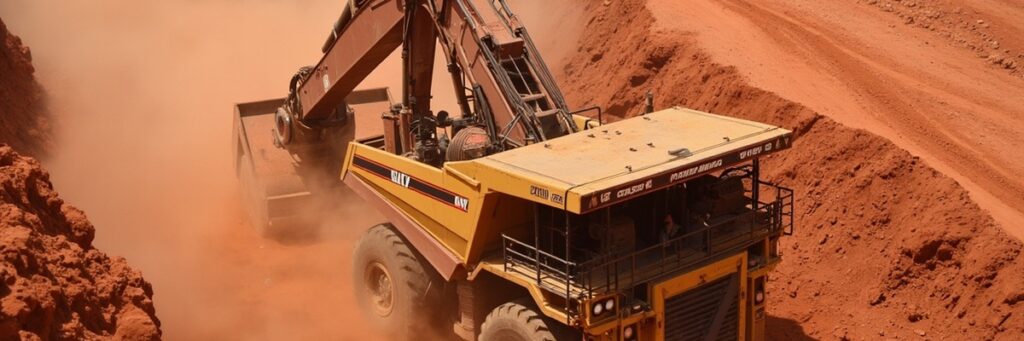
The Africa mining equipment market is poised for significant expansion, with excavators representing 29.6% of the projected $896.73 billion global surface mining equipment market in 2026. Rising commodity demand, new mine development, and infrastructure investments are driving unprecedented equipment procurement across African mining operations.
Mining Equipment Market Size and Growth Projections
The global surface mining equipment market was valued at USD 842 billion in 2025 and is projected to reach USD 896.73 billion in 2026, expanding to USD 1,683.29 billion by 2036 at a 6.50% CAGR. Excavators constitute the largest product segment, representing 29.6% of total market revenue in 2026, establishing their dominance in mining applications worldwide.
Africa’s participation in this growth is substantial, driven by expanding mining operations across South Africa, Ghana, Zambia, the Democratic Republic of Congo, and Tanzania. The continent holds significant reserves of gold, diamonds, copper, cobalt, and lithium—critical minerals for global energy transition technologies. New mine developments and expansion projects require substantial earthmoving equipment including excavators, bulldozers, and haul trucks.
Key Demand Drivers in African Mining
Several factors drive mining equipment demand across Africa. Critical mineral exploration has intensified, particularly for cobalt and lithium supporting battery manufacturing supply chains. Infrastructure development associated with mining operations—including roads, rail connections, and port facilities—requires extensive earthmoving capabilities.
Major projects like the Simandou Trans-Guinean Railway exemplify the infrastructure-mine development nexus, with railway construction creating immediate equipment demand while enabling future mineral transport. The Lobito Corridor in Angola and Zambia represents similar infrastructure-mining integration opportunities.
The Africa bulldozer market is expected to register rapid growth, reflecting the broader earthmoving equipment demand trajectory. Construction and mining equipment markets are attracting substantial investments driven by expanding operations, infrastructure projects, and adoption of advanced technologies including autonomous and electric equipment.
Equipment Requirements for African Mining Operations
African mining operations require diverse equipment ranging from large production excavators to smaller maintenance machines. Primary equipment categories include hydraulic excavators (20-50 ton class for loading and trenching), bulldozers for site preparation and ore handling, haul trucks for material transport, and drilling equipment for blast hole preparation.
For loading applications, 30-50 ton hydraulic excavators dominate, with brands including Caterpillar, Komatsu, Hitachi, and increasingly SANY and XCMG competing for market share. The SANY Holcim partnership demonstrates how Chinese manufacturers are securing major mining customer contracts.
FAQ
What is the projected size of the Africa mining equipment market in 2026?
The global surface mining equipment market is projected at USD 896.73 billion in 2026, with excavators representing 29.6% of market revenue. Africa’s share continues growing driven by new mine development across gold, copper, cobalt, and lithium operations. The market is expanding at approximately 6.5% CAGR toward USD 1.68 trillion by 2036.
Which countries drive the most mining equipment demand in Africa?
South Africa, Ghana, Zambia, Democratic Republic of Congo, Tanzania, and Guinea represent the highest-demand markets. South Africa dominates based on established mining infrastructure, while DRC and Zambia benefit from copper belt development. Guinea’s Simandou iron ore project represents a major new demand source.
What types of excavators are needed for African mining?
Mining applications typically require 30-50 ton hydraulic excavators for loading and handling operations, with larger 70+ ton machines for high-production operations. Caterpillar 336 and Komatsu PC490 class machines represent common specifications, with Chinese brands increasingly competitive for cost-sensitive operations.
How are Chinese excavator brands performing in African mining?
Chinese brands including SANY and XCMG are gaining mining market share through competitive pricing and improving quality. Major partnerships like the SANY Holcim 126M deal demonstrate Chinese manufacturer capabilities in demanding mining applications. However, Caterpillar and Komatsu maintain strong positions in high-specification mining applications.
Conclusion
The Africa mining equipment market presents substantial opportunities as the sector expands to meet global critical mineral demand. Excavators remain the dominant equipment category, representing nearly 30% of the surface mining equipment market. Buyers should evaluate total cost of ownership, dealer support capabilities, and equipment lifecycle performance when procuring for African mining operations. Strategic partnerships with established manufacturers and dealers provide the support infrastructure necessary for successful mining equipment deployment across Africa’s diverse operating environments.