
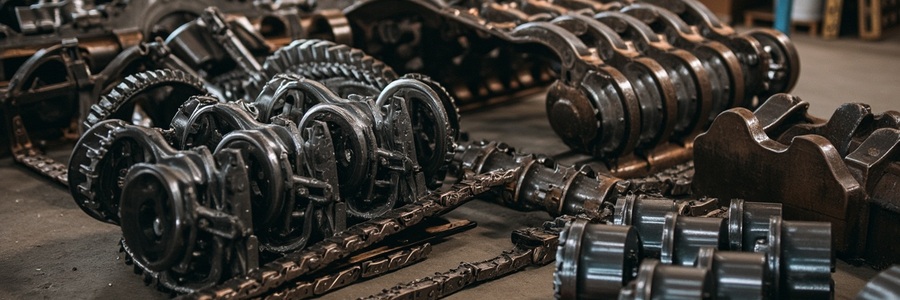
Track roller fitment is an identity-and-measurement decision, not a model-name shortcut. Before a buyer compares price, the seller should be able to connect the requested roller to the exact machine, roller position, mounting arrangement, dimensions and quantity. Missing one of those links can create an installation delay, uneven undercarriage wear or an incomplete shipment.
Quick answer: send the machine brand, exact model, serial/PIN, both undercarriage-side photos, the old roller position, readable part number if present, single/double-flange type, labeled measurement photos and the required quantity per side. PRIMA should hold fitment, price, availability, warranty and shipment claims until the requested evidence is attached to the quote.
This page is the dimensional-fitment support record. Use the track roller commercial buyer guide for condition/quality/packing decisions and the undercarriage system owner when chain, sprocket, idler, shoe and roller wear must be reviewed together. Those pages are supporting stages of one procurement path, not competing owners for the same search intent.
What identifies the machine before any roller measurement?
Start with the machine identity file. Record the brand, full model suffix and serial/PIN from a readable plate photo. Add one wide photo of each undercarriage side and one close view showing where the lower roller sits in the frame. If the machine has been rebuilt, modified or fitted with a different undercarriage, record that explicitly. A familiar model name does not prove that every serial range or field configuration uses the same roller.
Keep the plate photo and machine views in the same RFQ folder as the roller measurements. Do not crop away the scale, measurement origin or mounting context. If the plate is unreadable or the configuration cannot be confirmed, the quote should state fitment pending rather than presenting a guessed match.
Which track roller position and flange type must be separated?
Confirm that the requested part is a lower track/bottom roller, not a top/carrier roller. Then record whether the old roller has a single flange, double flange or another arrangement. Photograph the roller in position before removal when possible, and label left/right side plus its position in the roller sequence. A loose part photo without machine context is weaker evidence because the buyer cannot see where it came from.
Quantity must be counted from the exact machine. Record the number required per side and the total order quantity separately. Do not infer quantity from a generic model table. If the buyer plans a partial replacement, note which positions are being changed and ask whether remaining rollers, chain, sprocket and idler wear have been inspected.
Which dimensions should appear in a labeled measurement file?
The measurement file should show each measuring point, the complete tool reading and the unit. Depending on the mounting design, useful fields can include tread diameter, outer flange diameter, overall width, inside/outside spread, shaft diameter and length, mounting width, mounting-hole diameter, bolt-center spacing and thread specification. Not every design uses every field, so the seller should explain which dimensions control the proposed match.
| Decision field | Required evidence | Hold rule |
|---|---|---|
| Machine identity | Plate photo, full model suffix, serial/PIN and configuration views | No exact-fit statement if identity is incomplete |
| Roller identity | Old-part photos, readable number if present, lower/carrier position and flange type | Do not infer OEM or condition from paint, logo or carton |
| Mounting geometry | Labeled measurement photos with tool, origin and unit visible | Do not confirm a match from an unlabeled dimension list |
| Quantity | Count per side, total order quantity and replacement positions | No generic quantity-per-model assumption |
| Current item | Dated item photos, proposed part number/source, condition/status and dimensions | No stock, availability, condition or compatibility claim without the item file |
| Commercial terms | Written quote, quantity, condition, exclusions, packing, lead time and warranty if offered | No fixed price, delivery or warranty promise before a dated quote |
Official manufacturer catalogs illustrate why this is part-specific work. Current Cat parts pages publish different dimensions, flange arrangements and compatible-model lists for individual roller part numbers, and warn that configuration changes can affect fit. See the official examples for Cat 265-7674 and Cat 604-1761. These references explain the verification method; they do not prove that PRIMA holds either item or that a listed model automatically matches the buyer’s machine.
How should a proposed item be proven before quotation?
A quote should point to a dated item record, not a generic catalog picture. The record should show the actual proposed roller from multiple angles, the readable part number or source reference when available, the condition/status being offered and the same controlling dimensions used in the buyer’s request. If the item is not yet selected, the response should remain a sourcing brief and clearly say that availability is pending.
Do not use color, logo, packaging or a filename as proof of manufacturer, OEM status, material, heat treatment, hours, service life or warranty. Those facts require a traceable source document or written supplier/manufacturer evidence. When evidence is missing, the safe output is a question or hold—not a stronger marketing sentence.
Why must the rest of the undercarriage be checked?
A roller operates with the track chain, sprocket, idler, shoes and track tension. Ask for close views of chain pitch/link wear, sprocket tooth profile, idler surface, shoe condition, track sag/tension and any uneven wear pattern. This does not mean every component must be replaced together. It means the buyer should not evaluate a new roller as if the surrounding system has no effect on fit and wear.
Use the undercarriage parts decision guide for the system check. If the request includes several part families, route it through the excavator parts supplier evidence guide. For uncertain markings, follow the part-number verification owner.
What should the buyer verify before shipment?
Before payment or release, reconcile the selected item photos, measurement sheet, quoted part number/source, quantity and packing list. Request current packing photos that show labels and the number of packages. If a warranty is offered, require its period, coverage, exclusions, evidence needed for a claim and responsible party in writing. If lead time or delivery is important, keep it tied to the dated quote, confirmed destination and shipping terms.
PRIMA should not describe a generic illustration as shipment evidence. Only dated photos or documents tied to the selected item and order can support an item-level packing or inspection statement.
What should a qualified track roller RFQ contain?
- Machine brand, full model suffix and readable serial/PIN plate photo.
- Wide left/right undercarriage photos and the roller position to replace.
- Old roller photos, readable number if present and single/double-flange type.
- Labeled measurement photos with unit and measuring origin visible.
- Quantity per side, total quantity and whether the request is a partial or full set.
- Destination country/port, requested shipment timing and packing constraints.
- Required condition/source category and any written warranty requirement.
For a structured file, use the excavator parts RFQ checklist. Current catalog records can be browsed at PRIMA spare parts, but a public record is not an availability or compatibility guarantee until the item-level evidence file passes.
Send the evidence file, not only the model name.
Use WhatsApp +86 138 2031 8813 or email [email protected]. PRIMA will first identify missing fields and evidence holds; a final match, price, availability, packing, lead time or warranty statement requires a dated proposed-item record and written quote.
Can a model name alone confirm track roller fitment?
No. Treat the model as a starting point. Confirm the serial/PIN, configuration, roller position, flange arrangement, mounting geometry and old-part evidence before accepting an exact-fit statement.
Does a public catalog page prove current stock or compatibility?
No. A catalog route can help organize candidates, but current stock, condition and compatibility require a dated item record tied to the buyer’s machine evidence.
Should every roller on both sides be replaced together?
Not automatically. Record the wear pattern and replacement positions, inspect the surrounding undercarriage and obtain a written recommendation for the exact machine. Do not infer a full-set quantity from a generic model table.
What warranty should a buyer accept?
Accept only the warranty that appears in the dated written quote, including period, scope, exclusions, claim evidence and responsible party. This page makes no general warranty promise.