
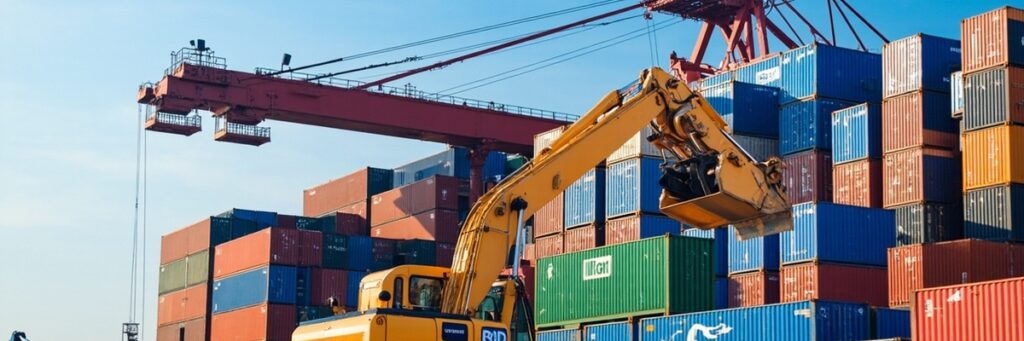
If you have never coordinated shipping a 20-ton excavator from China to West Africa, let me save you some sleepless nights: it is a lot more complicated than just putting it on a boat. I learned this the hard way three years ago when we shipped our first machine to Nigeria. The machine arrived fine — but the paperwork took another month to catch up, and the client spent that month furious at us. We have since shipped dozens of machines to Kenya, Ghana, Tanzania, and South Africa, and the process is now pretty smooth. Here is what actually works.
Choose the Right Shipping Method: RORO vs Flat Rack
There are two ways to move an excavator from China to Africa: Roll-on/Roll-off (RORO) and flat rack container. Each has trade-offs.
RORO is usually cheaper and faster — the excavator drives directly onto the vessel and is secured on the car deck. The problem is that not all African ports accept RORO vessels, and fewer vessels service those routes. Major Chinese ports like Shanghai, Tianjin, and Huanghua all have regular RORO sailings, but the destination port options in Africa are limited.
Flat rack shipping means loading the excavator into a 40-foot flat rack container or platform. It costs more but works for any port. The excavator is lifted on and off the vessel, which requires crane facilities at both ends. Most East African and South African ports handle flat rack well. West African ports like Lagos and Dakar also handle them, but you need to verify crane availability in advance.
We always recommend flat rack for our African clients because the additional cost — typically 15-20% more than RORO — is worth eliminating the port limitation risk. Our team coordinates with shipping lines that have regular departures from Tianjin and Huanghua to the major African ports.

The Documentation That Makes or Breaks Your Shipment
This is where most first-time importers stumble. Shipping an excavator to Africa requires more documentation than most people expect, and missing any single document can mean the machine sits at the port accumulating demurrage fees.
Required documents include: Bill of Lading (BOL), Commercial Invoice, Packing List, Certificate of Origin, Import License (country-specific), phytosanitary certificate if the machine has wooden components, and customs declaration forms for both China export and Africa import. We provide all Chinese export documentation through our logistics partner. For the import side, we connect clients with customs brokers at their destination port who know the local requirements.
One thing that surprises people: some African countries require a Soncap or similar product certification for imported machinery. Nigeria, for instance, has strict standards. We have a network of agents in Lagos and Abuja who handle this regularly. Tell us your destination country before you buy, and we will tell you exactly what documentation you need and who will provide it.
Shipping Costs and Transit Times: What to Expect
Shipping from Tianjin or Huanghua to West Africa typically runs 45-60 days in transit plus port time. From Shanghai to East Africa is faster — about 25-30 days. The cost varies significantly by port and by season, but rough estimates:
Tianjin to Lagos: approximately $2,500-3,500 for a 20-ton excavator on flat rack. Tianjin to Mombasa: approximately $1,800-2,500. These are ocean freight estimates and do not include port handling, customs clearance, or inland transport to your final location.
Bill of lading terms matter enormously here. We always ship under FOB or CIF terms depending on what our clients prefer. Under FOB, you manage the freight from Chinese port onward. Under CIF, we handle the freight and insurance to destination port. For first-time African buyers, we strongly recommend CIF — the cost is slightly higher but the peace of mind is worth it.

Clearing Customs at Your African Port
Every African country has different customs procedures, and the difference between a smooth clearance and a nightmare is usually the customs broker you use. We maintain relationships with certified customs brokers at ports in Nigeria, Kenya, Tanzania, Ghana, and South Africa.
For Nigeria specifically: the Nigeria Customs Service has strict rules about used machinery imports. Machines above a certain age threshold face restrictions, and emissions standards apply. Our Nigerian broker partners know exactly which documentation to present and in what order to avoid delays. We have seen machines sit at Apapa port for weeks because the broker did not know the specific form numbers required. The right broker makes all the difference.
In Kenya, the Kenya Bureau of Standards (KEBS) requires standards marking for imported machinery. Our Kenya partners handle this as a matter of routine. Tanzania has its own TABORA system for customs declarations. We have agents familiar with all three.
Here is what we tell every African client: budget for 7-14 days of port clearance after the vessel arrives, and do not book any equipment hire or site preparation that depends on the machine arriving on a specific date. Delays happen and they are almost never within anyone is control once the ship enters African waters.
How We Help: Full Export-Import Coordination
We have shipped excavators to Africa for years and have developed a process that removes as much complexity as possible from the client is side. Here is what we handle:
We arrange the container or flat rack booking, manage the Chinese export documentation, connect you with an approved customs broker at your destination port, and provide you with a tracking reference so you know exactly where the machine is at all times. We use our shipping guide for excavators from China as a reference for all clients, which covers the full process step by step.
Payment terms are straightforward: 30% deposit when you confirm the order, 70% before we release the machine for shipping. We do not require T/T payment to a Hong Kong account — all funds are wired to our mainland China company account, which is registered and regulated under Chinese commercial law. This matters for your audit trail and for any financing you might need from a bank.
How long does it take to ship an excavator from China to Africa?
Tianjin to Lagos: approximately 45-60 days transit plus 7-14 days port clearance. Tianjin to Mombasa: approximately 25-30 days transit plus 7-14 days clearance. Always add buffer time for port handling. Do not schedule equipment deployment based on the vessel arrival date — schedule it based on when you expect the machine to clear customs.
What is the cost of shipping an excavator to Africa?
Ocean freight for a 20-ton excavator on flat rack typically runs $1,800-3,500 depending on destination port and season. This does not include port handling fees, customs clearance, import duties, or inland transport. Total landed cost in Africa typically runs 1.5-2x the ocean freight figure when you include all ancillary costs.
Can you recommend a customs broker in my African port?
We have trusted broker partners at ports in Nigeria (Lagos/Apapa), Kenya (Mombasa), Tanzania (Dar es Salaam), Ghana (Tema), and South Africa (Durban). We connect you directly with our broker contact at no additional cost — they charge standard rates that you pay directly. Their value is knowing the specific procedures and who to talk to inside each customs office.
Start the Conversation Before You Buy
The biggest mistake African buyers make is treating shipping as an afterthought. They negotiate a great price on the machine, then scramble to figure out how to get it. By then, valuable time has been lost. We recommend telling us your destination port before you commit to a purchase. We will give you a firm landed cost estimate — machine price plus shipping plus all port and customs fees — so there are no surprises. That number, agreed in advance, is the most valuable thing we can offer an African buyer.