
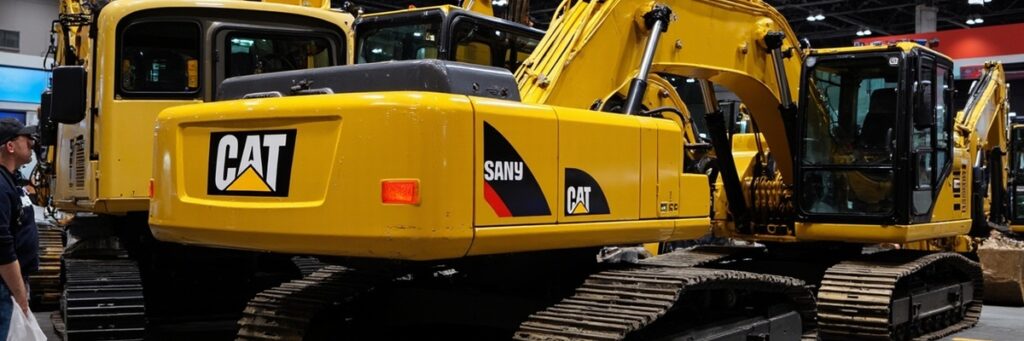
Caterpillar, Komatsu and SANY can all be reasonable used-excavator choices. The brand name alone does not identify the safer purchase. Compare the exact machine, its configuration, operating evidence, inspection results, local parts path and landed cost. A well-documented machine that fits the job can be a better purchase than a more famous badge with missing records.
This page is the narrow owner for buyers comparing these three brands. For a broader model-and-work-condition process, use our excavator brand and model selection guide. For two exact 20-ton-class models, see the CAT 320D vs Komatsu PC200 comparison.
Quick answer: choose the documented machine, not a generic brand ranking
A defensible shortlist starts with the required operating weight, reach, digging depth, attachment, transport limit and local service capability. It then removes any machine whose identity, hours, cold start, hydraulic behavior, undercarriage condition or ownership documents cannot be checked. Only after those gates should price, fuel use, expected repairs and resale evidence be compared.
- Caterpillar: verify the exact model suffix, serial/PIN, regional configuration, electronic-monitor evidence and the local source for model-specific parts.
- Komatsu: verify the PC model and dash series, serial plate, monitor hours, hydraulic response and part-number path for that exact serial range.
- SANY: verify the full SY model designation, serial plate, market configuration, controller/monitor evidence and destination support for the exact variant.
These are verification priorities, not claims that every machine from one brand has the same quality, fuel consumption, service life or resale value.
Current official specifications are reference points, not used-inventory proof
The table below uses current manufacturer pages only to show why model names and configurations matter. It does not prove that a used unit offered for sale has these specifications. Used generations, regional emissions packages, booms, arms, buckets, counterweights and attachments may differ. Match every offered machine to its own identification plate and configuration evidence.
| Current official reference | Published operating weight | Published engine power | Published work-equipment reference | What a used buyer must still verify |
|---|---|---|---|---|
| Caterpillar 320 | 22,600 kg | 128.5 kW | Maximum digging depth shown as 6,720 mm | Generation, suffix, engine/emissions package, boom/arm, bucket, PIN and actual condition |
| Komatsu PC210LC-11 | 23,240 kg | 123 kW | Bucket capacity shown as 0.97 m³ | Dash series, regional specification, attachments, serial range and actual condition |
| SANY SY215C | 21.9 t | 118 kW | Bucket capacity shown as 0.93 m³ | Full variant, market configuration, attachments, serial number and actual condition |
Boundary: do not use the numbers above to price, ship or promise the performance of a used unit. Ask for the exact machine file first.
The ten-part evidence file every shortlisted machine needs
- Identity: clear identification/PIN or serial plate, full model designation and matching seller document.
- Configuration: boom, arm, bucket, track width, counterweight, quick coupler and installed attachments.
- Hours evidence: monitor photo or video plus an explanation of what can and cannot be independently verified. Displayed hours are not automatically lifetime hours.
- Cold start: continuous video beginning before the engine starts, with visible machine identity and ambient context where practical.
- Hydraulic function: boom, arm, bucket, swing and travel operated through a repeatable cycle after warm-up.
- Leaks and structure: close views of cylinders, pump area, final drives, slew area, boom/arm weld zones, frame and counterweight.
- Undercarriage: both sides, sprockets, idlers, rollers, shoes and track-chain condition. Use the used excavator inspection checklist to define the shot list.
- Fault evidence: monitor warnings, active fault codes and any diagnostic report that can be tied to the same machine and date.
- Service and repair record: available invoices, component replacements and maintenance entries, labeled as seller-provided unless independently confirmed.
- Export file: ownership/sale document, commercial invoice data, packing/loading plan and destination document requirements.
If a seller cannot supply a critical item, record it as an unresolved risk. Do not fill the gap with a brand reputation claim or a photo filename.
Brand-specific checks for Caterpillar, Komatsu and SANY
Caterpillar used excavator checks
Ask for the complete model suffix and PIN before assuming two CAT machines use the same parts or settings. Photograph the monitor at key-on, idle and working temperature. Record active warnings and confirm whether any diagnostic report belongs to that same PIN. Inspect the hydraulic pump area, cylinders, swing system, travel drives and undercarriage under load. If parts availability affects the decision, build a destination-specific list from verified part numbers rather than a generic “CAT parts are available” statement. Our CAT excavator parts buyer checklist shows the required identifiers.
Komatsu used excavator checks
Record the full PC model, dash series and serial plate. Check the monitor, warm hydraulic response, travel behavior, swing stopping behavior, cylinders, pump area and undercarriage. A PC200 and PC210 from different series or regions should not be treated as interchangeable. Confirm the destination parts route using the exact serial and part number. Use our used Komatsu inspection guide and Komatsu parts fitment guide.
SANY used excavator checks
Capture the complete SY model and suffix, identification plate, controller/monitor state and installed configuration. Test cold start, warm hydraulics, swing, travel and attachment functions. Confirm the exact destination support route for parts and diagnostics instead of assuming that support in one country applies everywhere. For a structured process, see the used SANY inspection guide and SANY parts buyer guide.
How to compare three machines under the same test conditions
Marketing specifications do not replace a side-by-side condition test. Ask the seller or inspector to use the same sequence and record the same evidence for every candidate:
- Show the plate and the entire machine before startup.
- Record a genuine cold start without editing out the first crank.
- Warm the machine and note monitor warnings or abnormal sounds.
- Cycle boom, arm and bucket; operate swing in both directions; travel forward and reverse.
- Hold functions long enough to reveal drift, hesitation or visible leakage where safe.
- Inspect both undercarriage sides and measure wear where a qualified inspector can do so.
- Repeat the same camera angles and evidence labels for every candidate.
Ask for an inspection scope in writing. A video call, page visit or seller statement is not equivalent to an independent inspection report. Review our inspection-report verification guide before paying.
Compare destination support with a parts-path test
“Global support” is too broad for a purchase decision. For each candidate, choose several maintenance and failure-critical items, then document:
- the exact part number or serial-number lookup method;
- one local or regional source that will quote the identified part;
- whether the part is genuine, aftermarket, used or rebuilt;
- quoted lead time, packing and freight basis;
- the technician or diagnostic path available in the destination market.
Start with the part-number verification process. A supplier name, logo or model family is not enough to confirm fitment.
Compare landed risk, not only purchase price
Request the same commercial basis for all three machines. A useful comparison sheet separates machine price, inland transport, dismantling, loading method, export charges, ocean freight, destination charges, taxes/duties, inspection, initial service and unresolved repair allowance. Do not present one total when the included items differ.
Confirm the transport envelope and loading plan from the exact configuration. Boom/arm, bucket, cab, counterweight and track width can change the shipment plan. Use the used excavator shipping and document checklist.
Treat resale and total-cost claims as local evidence questions
PRIMA does not publish a universal five-year resale percentage or a universal brand cost ranking on this page. Resale depends on model demand, age, condition, hours credibility, configuration, documentation, local buyer pool and the time allowed to sell. Fuel and repair cost depend on work cycle, operator behavior, maintenance and machine condition.
If resale matters, collect recent comparable listings or transactions in the destination market and label each source and date. If operating cost matters, run a defined job-cycle test or use the buyer’s own fleet records. Unsupported percentages should not decide a high-value purchase.
A weighted decision matrix for a qualified shortlist
| Decision factor | Suggested weight | Evidence required |
|---|---|---|
| Job and configuration fit | 20% | Required lift/dig/reach/attachment and transport envelope matched to exact machine |
| Identity and document confidence | 15% | Plate, model, serial/PIN and documents aligned |
| Inspection result | 25% | Cold start, hydraulics, structure, leaks, undercarriage and fault evidence |
| Destination parts and technician path | 15% | Serial-specific parts route and local service evidence |
| Landed cost and repair allowance | 15% | Same Incoterm/scope, freight basis and documented risk allowance |
| Resale evidence | 10% | Dated, destination-specific comparable evidence |
Change the weights to match your business. Score a factor only when the required evidence exists; mark missing evidence as unresolved rather than giving it an optimistic score.
Send a qualified Caterpillar, Komatsu or SANY RFQ
For a machine-specific shortlist, send: destination country/port, required model or operating class, work type, attachment, budget basis, preferred shipping window and the evidence items you require. If you already have a machine offer, include the listing URL, plate photo and seller-provided records.
Contact PRIMA by WhatsApp: +86 138 2031 8813 or email: [email protected]. PRIMA will confirm what evidence is available for the exact unit; model availability, year, hours, condition, price and delivery are not promised until they are tied to a specific machine record. You can also use the contact page.
Frequently asked questions
Is Caterpillar always better than Komatsu or SANY?
No. A brand-level answer cannot establish the condition, configuration, maintenance history or landed risk of an individual used machine. Compare exact units using the same evidence file and test sequence.
Which brand has the best resale value?
There is no universal percentage that is reliable across countries, models and conditions. Use dated comparable evidence from the destination market and adjust for age, configuration, hours credibility, inspection result and time to sell.
Can published new-machine specifications identify a used machine?
No. They are reference points only. The used machine may be another generation, regional variant or configuration. Verify the identification plate, full model designation and installed equipment.
What evidence should be requested before paying?
At minimum: machine identity, configuration, continuous cold-start evidence, warm hydraulic and travel tests, undercarriage and structural views, monitor/fault evidence, available service records, commercial terms and export documents. Payment controls should match the unresolved risk.
How should a buyer compare parts availability?
Test the route for the exact serial and several identified parts in the destination market. Record supplier, part status, lead time, packing, freight basis and technician/diagnostic availability. A general dealer-network claim is not enough.
Evidence and editorial limitations
This comparison does not certify any unlisted machine, guarantee fitment, quote current inventory, promise delivery or replace a qualified independent inspection. Official manufacturer pages can change and may describe current models rather than the used generations being offered. All machine-specific claims should be tied to a dated record for that exact unit.
Current primary references
- Caterpillar 320 official product page, accessed 29 August 2026.
- Komatsu PC210LC-11 official product page, accessed 29 August 2026.
- SANY SY215C official product page, accessed 29 August 2026.