
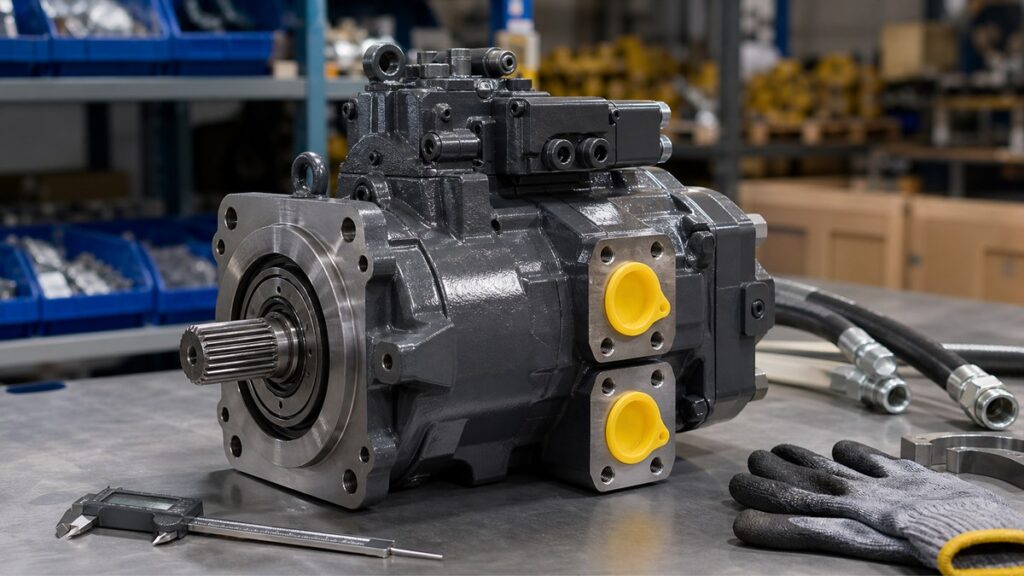
Ask PRIMA about an excavator hydraulic pump by sending the machine model or a clear pump/nameplate photo and a reply contact. Start with the details you have; the exact part, configuration, source, condition and availability must be confirmed before an order.
An excavator model name alone is not enough: pumps used within one model family can differ by part number, rotation, displacement, shaft, mounting, port layout, regulator or controller and through-drive arrangement.
Practical buyer answer
Start with photos of the machine plate and old pump nameplate, then record all visible identifiers and configuration details. Diagnose the hydraulic symptom before treating pump replacement as confirmed. Compare official/OEM, aftermarket, used and rebuilt candidates only when each option has a disclosed source, exact condition/status, available test evidence, written exclusions and the same delivery scope.
Compare pump identity, condition and quote scope
This guide explains what evidence to compare for a proposed pump. The condition categories below are information for evaluating a quote, not a statement that PRIMA currently stocks every category. It does not diagnose a machine remotely, declare a pump compatible, confirm current stock or promise a price, test result, warranty, lead time or delivery.
| Buyer job | Related guide |
|---|---|
| Compare pump condition/source options and build one quote file | This guide |
| Prepare diagnostic evidence before deciding to replace a pump | Hydraulic-pump replacement evidence checklist |
| Check a Hitachi-specific pump route | Hitachi hydraulic-pump buyer guide |
| Check general part-number and machine fitment evidence | Excavator parts fitment checklist |
Confirm pump identity and configuration for a quote
Record what can be verified from the machine and removed pump. Mark any unavailable field as unknown; do not fill gaps from a similar listing or filename.
| Identity field | Evidence to send | Why it matters |
|---|---|---|
| Machine identity | Brand, full model/suffix, readable serial/PIN plate and destination market if known | Separates machine variants and supports official catalogue or dealer checks |
| Pump identity | Full nameplate photos, maker/model codes, part or casting numbers and all labels | Prevents a model-only quotation from becoming an assumed interchange |
| Physical configuration | Clear photos of every side; mounting flange/holes; shaft or spline; port positions and sizes; regulator/controller location and connector; through-drive or tandem section, as applicable | Configuration differences can change installation and control compatibility |
| Operating code | Documented rotation, displacement and controller/regulator code from an authoritative record when available | These values must not be guessed from appearance |
| Failure context | Symptoms, when they occur, recent work, oil/filter condition and technician test notes | A symptom alone does not prove the pump is the root cause |
Diagnose before replacing the pump
Slow functions, weak travel, abnormal noise, overheating or low force can involve the pump, regulator/controller, valves, motors, cylinders, hoses, suction restriction, contamination, oil condition, sensors or control signals. The relevant tests depend on the machine and service information. They should be planned and performed by qualified personnel with suitable gauges, flow equipment and safety controls.
A useful diagnosis record identifies the machine, tester and date; test points and conditions; oil temperature; engine speed; commanded function; measured pressure, flow or case-drain result when safely obtained; and the applicable specification source. PRIMA does not treat a photo, sound description or dashboard message as proof that pump replacement is required.
How to compare official/OEM, aftermarket, used and rebuilt pumps
These labels describe sourcing routes, not automatic quality levels. Require the seller to define the exact status in writing.
| Route | Minimum evidence | Do not assume |
|---|---|---|
| Official/OEM route | Named authorized channel, exact part number and supersession record, invoice description, item identity and written warranty terms | That an “OEM” label proves source, fitment, stock or coverage |
| New aftermarket | Disclosed manufacturer/source, exact interchange basis, new-item status, configuration, test or quality record, serial/batch where used and written terms | That all aftermarket pumps share one quality or lifespan |
| Used | Actual proposed-item photos, source/donor details when available, date/location, known service history, visual findings, available functional or bench evidence and disclosed unknowns | Hours, remaining life or internal condition from appearance |
| Rebuilt/remanufactured | Core identity, rebuilder identity, work date, replaced/reused component list, measurement or cleanliness controls, test report, final item identity and warranty/claim scope | That “rebuilt” means every wear component was replaced or that the result equals an official reman unit |
PRIMA is an independent supplier, not an authorized dealer for the excavator or hydraulic brands referenced on this page. A candidate can be described as genuine, OEM, official reman or authorized-channel only when its source documents support that exact statement.
What useful pump test evidence includes
A test video or report is useful only when the buyer can connect it to the proposed item and understand the method. Ask for:
- proposed-item nameplate or identifier visible before or during the record;
- test date, tester or facility and test-equipment identification;
- configuration and controller/regulator used during the test;
- oil type and temperature, input speed and relevant pressure/flow/case-drain conditions;
- measured results with units and the acceptance specification or agreed buyer limit;
- leak, noise, temperature or control observations;
- limitations: for example, visual-only, no load, partial function, donor-machine test or bench-test scope.
No test should be represented as completed unless the exact record exists. A generic test-stand image, another pump’s video or an unlabeled result is not item-level evidence.
Quote and warranty evidence
Make the commercial quote auditable. It should identify the proposed pump, source/status, condition, included controller/regulator and fittings, excluded work, quantity, currency, Incoterm, packing, dispatch basis and quote-validity date. If a core return, deposit or exchange is involved, write the core criteria, deadline, freight responsibility and rejection conditions.
Warranty is a written commercial boundary, not a quality adjective. Record duration or event limit, covered component and failure types, installation/commissioning requirements, contamination and overheating exclusions, proof required for a claim, labor/freight responsibility and the remedy. Do not treat a warranty statement as proof of fitment or remaining life.
Export packing and receiving evidence
- Before packing: record the item identifier and all sides; handle residual fluid according to the item, carrier and destination requirements.
- Protect openings: cap or plug every exposed port and protect machined faces, shaft/spline, connector and regulator from contamination and impact.
- Control movement: use a base, blocking and crate appropriate to the actual weight and center of gravity; do not let the pump move inside the package.
- Control moisture: use suitable wrapping, barrier or desiccant when required without trapping contamination against critical surfaces.
- Trace the package: label the package and packing list with the agreed item/quote reference, gross/net weight and handling marks when verified.
- Record acceptance: save dated open-pack, closed-pack and shipping-mark photos; on receipt, photograph external condition before opening and preserve carrier evidence for any claim.
Official references confirm why exact configuration matters
The references below illustrate serial-number lookup and configuration fields, not PRIMA stock, authorization or pump fitment. Cat and Bosch Rexroth were rechecked on 19 September 2026; the Parker record remains a 29 August reference, not a freshly verified item. Match the manufacturer documentation to the proposed pump before relying on a specification.
- Cat Parts Diagram Lookup asks for equipment and serial number to show relevant parts diagrams.
- Parker’s PD-series product record exposes fields such as controller, port connection/position, shaft, mounting, displacement and rotation.
- Bosch Rexroth’s pump selector example exposes a type code, series, drive shaft, line connection and rotation. The linked PR4-3X is a radial-piston-pump example, not a specified replacement for an excavator.
Resolve these issues before payment
- Hold if the machine or pump identity cannot be linked to the proposed item.
- Hold if the seller claims interchangeability without a documented part/configuration basis.
- Hold if “new,” “OEM,” “used,” “rebuilt” or “reman” is not defined by source and condition evidence.
- Hold if a test claim has no item identifier, method, date or measurable result.
- Hold if the regulator/controller, rotation, shaft, mounting or ports are not resolved.
- Hold if packing, quote scope, exclusions or warranty responsibility are ambiguous.
Details to confirm after the first enquiry
For a first message, send the model or available pump photo, what you need and a reply contact. The fields below help confirm the proposed item before an order. Unknown facts stay unconfirmed; a model name does not establish fitment, stock, condition, price or delivery.
- Machine brand, full model/suffix and readable serial/PIN plate
- Old pump maker/model/part/nameplate and all-side photos
- Port, mounting, shaft/spline, rotation, regulator/controller and through-drive details as available
- Failure symptoms and any technician pressure/flow/case-drain findings
- Accepted option: official/OEM, aftermarket, used, rebuilt or more than one for comparison
- Quantity, destination country/port/final city, Incoterm and required timing
Ask PRIMA about your hydraulic pump
Use WhatsApp +86 138 2031 8813 or email [email protected]. You can also use the enquiry form. A first enquiry does not require a completed technical file.
Buyer FAQ
Can I order an excavator hydraulic pump by machine model only?
No. The full machine identity and old pump identity/configuration should be checked. Model-only quotation cannot resolve all part-number, port, shaft, rotation or regulator differences.
Is an OEM hydraulic pump always the lowest-risk option?
Not from the label alone. Verify the authorized source, exact part or supersession, proposed-item identity, applicability and written terms. A genuine route does not correct a wrong part number.
What proves that a rebuilt hydraulic pump was tested?
An item-linked record should state the tester/date, method and conditions, measured results and units, acceptance basis and limitations. A generic test video or “tested” statement is not enough.
Do slow excavator hydraulics prove that the pump must be replaced?
No. Similar symptoms can involve controls, valves, motors, cylinders, hoses, oil, contamination or other causes. Use machine-specific service information and qualified diagnosis before replacement.
For broader sourcing, use the excavator parts supplier guide and the parts-access verification guide.